
Hair Extensions for Thin Hair in NZ: The Best Methods for Fine and Fragile Hair
Quick answer
The safest hair extensions for thin hair in NZ are the ones that put the least weight and tension on each strand. A halo or flat silicone clip-ins suit fragile hair best because nothing stays attached. For longer wear, thin polyurethane tape-ins or nano tips, fitted lightly by a trained stylist, are the gentlest semi-permanent options.
Fine hair can wear extensions beautifully, but it has far less room for error. A method that sits happily in thick hair can show through, slip, or pull a fine strand until it snaps. This guide ranks the main methods by how gently they treat your own hair, so you can choose hair extensions for thin hair in NZ that add fullness without costing you the hair you already have.
In this guide
- Fine, thin or fragile: which one are you?
- What actually damages fine hair under extensions
- Extension methods ranked from gentlest to most demanding
- Ready-to-wear options for fragile hair
- Semi-permanent hair extensions for thin hair
- How much hair is too much?
- Aftercare that protects fine strands
- When a topper or fill-in makes more sense
- FAQ
Fine, thin or fragile: which one are you?

These words get used interchangeably, but the difference changes which method will work for you.
- Fine describes each strand. Roll a single hair between your fingers. If you can barely feel it, your strands are fine. Fine hair can still be dense, with plenty of strands on your head.
- Thin describes density, meaning how many strands you have. Thin hair shows scalp easily at the part, and a ponytail feels small around the bobble.
- Fragile describes condition. Bleached, heat-styled, postpartum or recently stressed hair breaks more easily, whatever its thickness.
Fine and thin hair needs a method that hides well, because little of your own hair covers the attachment. Fragile hair needs one that spreads load widely, or one you take out every night. If you are all three, start with ready-to-wear before anything semi-permanent.
What actually damages fine hair under extensions
Extensions don't damage hair just by being there. Damage comes from three forces, and every method handles them differently.
1. Tension at the root
Any attachment hanging off a small section pulls on the follicle every hour you wear it, and fine strands have less strength to absorb that pull. Constant tension over months is why section size and placement matter as much as the method itself.
2. Weight per attachment point
Total grams matter less than how those grams are shared out. A wide, flat tape spreads its weight across a broad strip of hair. A single bead or bond carries its strand's full weight on a tiny section.
3. Friction and wear at the bond
Where your hair meets a clip, bead, tape or bond, it rubs. Fragile hair wears through fastest there, which is why rough removal, overdue move-ups and sleeping on wet extensions cause most breakage.
Extension methods ranked from gentlest to most demanding

Here is how Superior Hair's methods compare for fine and fragile hair. Weights are taken from the current product listings and vary by length.
| Method | How it attaches | Strain on fine hair | Best for |
|---|---|---|---|
| Halo | Invisible wire rests on the head, no clips | Lowest. Nothing grips your hair | Very fragile hair, occasional wear |
| Scalp fill-ins | Small clip-in pieces | Low. 30g to 45g, worn by day | Thinning at the part, crown or temples |
| Seamless clip-ins | Clips on an ultra-flat silicone weft | Low to moderate. Removed nightly | Fine hair wanting full length and volume |
| Ultra seamless or Invisi tape-ins | Thin polyurethane tape sandwiching a fine section | Moderate. Weight spread across a wide strip | Fine hair in good condition, daily wear |
| Nano tips | Tiny bead, no heat or glue | Moderate. Light strands, small sections | Fine hair needing a flexible, discreet result |
| Hot fusion U-tips | Keratin bond sealed with heat | Higher. Heat at the bond, careful removal needed | Healthy fine hair, experienced stylist only |
| Genius, butterfly and traditional wefts | Weft sewn or beaded along a row | Higher. Weight concentrated along one row | Medium to thick hair; adapted cautiously for fine |
None of these are off limits for fine hair. Lower in the table simply means more depends on your stylist's sectioning and your aftercare.
Not ready to commit?
Ready-to-wear extensions go in and come out the same day, which makes them the lowest-risk way to see how extra hair looks and feels on fine strands.
Browse ready-to-wear hair extensions →Ready-to-wear options for fragile hair
If your hair is breaking, recovering from bleach, or shedding after a baby, give it a break from anything that stays attached. Ready-to-wear pieces add fullness by day and take the load off overnight.
The halo: no grip at all
Our classic halo extensions sit on an invisible wire that rests around the crown like a headband, with your top layer pulled over it. Because nothing clips, tapes or bonds to your hair, the halo puts no tension on the root, which makes it the gentlest option we sell for fragile hair. The tradeoff: it adds fullness through the lengths rather than at the top of your head, and it is not ideal for very high ponytails.
Seamless clip-ins: flat enough for fine hair
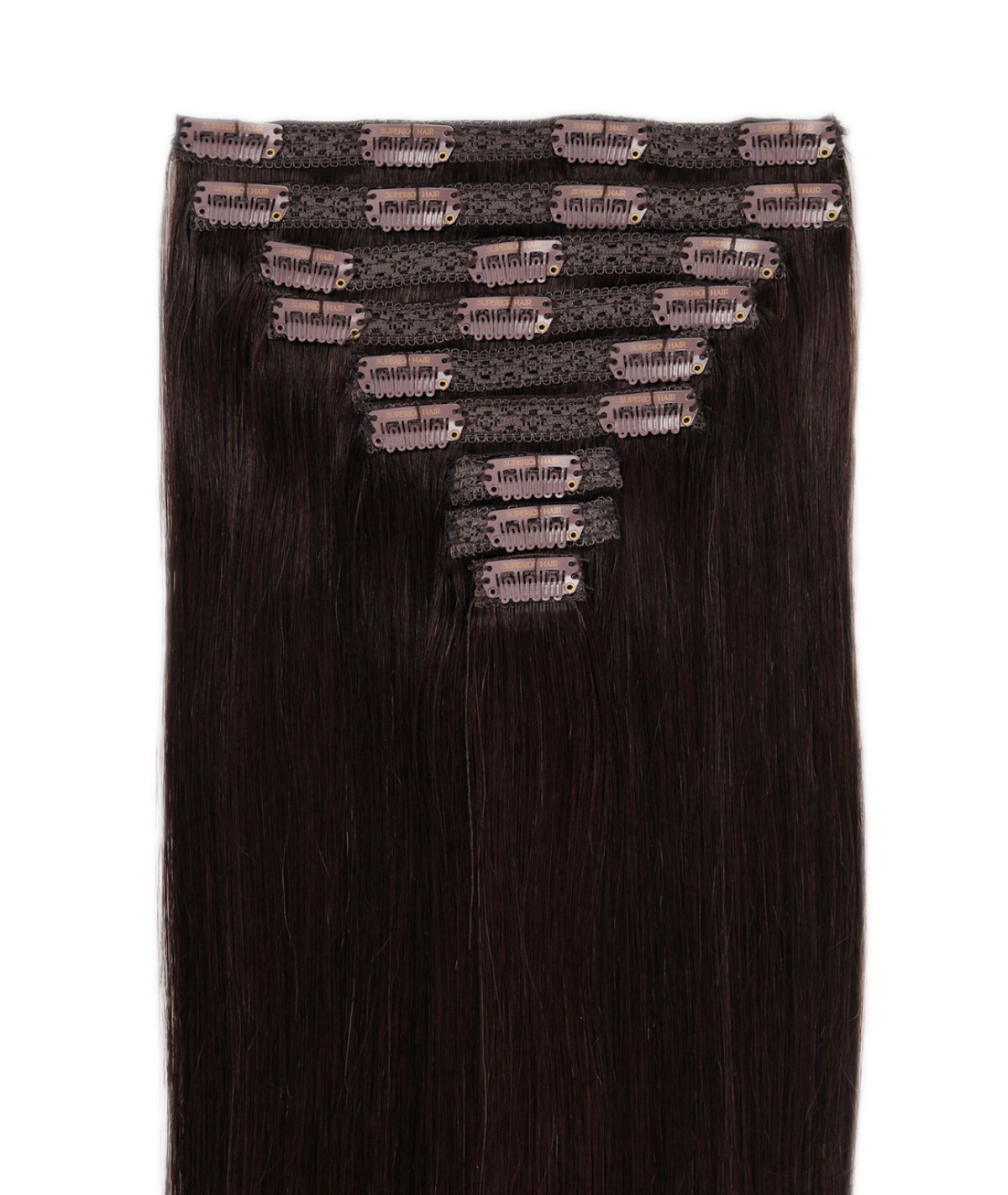
Classic clip-ins use a fabric weft that can leave a visible ridge in fine hair. Seamless clip-in extensions use an ultra-flat silicone base that lies close to the scalp, so there is less bulk to hide. Lightly tease each section's root first so the clip grips without dragging single strands. Take them out before bed, every time.
Scalp fill-ins: targeted density
If your lengths are fine but your part is widening, a full set is more hair than you need. Scalp fill-in pieces clip in at the part, crown or temples and weigh 30g at 12 inches or 45g at 18 inches. That is a fraction of a full clip-in set, which matters when the hair holding them up is delicate.
Semi-permanent hair extensions for thin hair
Semi-permanent extensions stay in for weeks, which means your hair carries extra weight around the clock. They are installed by a trained stylist, not at home, and a good stylist will assess your hair before agreeing to fit them. If you are unsure which commitment level suits you, our guide to semi-permanent vs ready-to-wear extensions walks through the lifestyle side.
Tape-ins: the usual first choice
Tape-ins sandwich a thin slice of your hair between two wefts. Our ultra seamless tape-in extensions use a very thin polyurethane base that spreads weight evenly and lies flat, which is why stylists often reach for them first with fine hair. Expect 8 to 10 weeks of wear before a move-up. Invisi tape skin wefts go a step further with a base designed to look like scalp, helpful right at the part line where fine hair hides very little.
For fine hair, ask your stylist to use half-width tapes in the top rows, keep the slice of natural hair proportionate to the weft, and avoid placing tapes too close to the hairline.
Nano tips: small and flexible
Nano tip extensions attach individual strands with a tiny bead, with no heat or glue involved. Because each strand is light and the beads are small, they move naturally and can be placed precisely around thinner patches. The risk sits in the section size: too little natural hair in each bead and that bead hangs off a handful of fine strands. Move-ups typically fall every 6 to 10 weeks, and skipping them lets the bead drift down and twist.
Methods to approach with care
Hot fusion U-tips last well, but the keratin bond is sealed with heat and removal needs patience. They can work on healthy fine hair in experienced hands; on fragile hair, we would steer you elsewhere. Weft methods (genius, butterfly and traditional) carry their weight along a single row, which suits medium and thicker hair best. Some stylists adapt them with shorter rows and lighter wefts, but that is a conversation to have in person.
Not sure of your shade?
Fine hair hides less, so a near-miss on colour shows quickly. Send us a photo and we'll match your shade, including root depth and any balayage, before you buy.
Get a free colour matchHow much hair is too much?
The most common mistake with fine hair is going too long and too heavy at once.
- Choose length you can blend. Extensions much longer than your own hair create a visible step at the ends, especially in fine hair. If your hair sits at your collarbone, a 16 to 18 inch set blends far better than 24 inches.
- Match weight to your density, not your goal. Our seamless clip-in sets run from 160g at 16 inches to 240g at 24 inches, and semi-permanent tape-in packs from 22g at 14 inches to 35g at 26 inches. Fine hair often looks better with fewer pieces placed well than with a full set.
- Add in stages. With semi-permanent methods, start with a lighter install. You can always add a pack at your first move-up once you know how your hair copes.
Every piece we sell is 100% Remy human hair with the cuticle aligned in one direction, which reduces tangling. That matters on fine hair, because knots where extensions meet your hair take your own strands with them when brushed out.
Aftercare that protects fine strands
- Brush from the ends up with a loop or soft-bristle brush, holding the hair just below the attachment so the bond takes no pull.
- Wash with sulphate-free products and keep conditioner away from tapes and beads. Oils and silicones near the bond loosen tape and let beads slide.
- Dry the roots fully. Damp hair stretches and snaps more easily, and moisture trapped at the bond weakens it.
- Keep heat below 180°C and always use a heat protectant. Fine hair and extensions both scorch faster than you expect.
- Sleep in a loose braid on a silk or satin pillowcase if you wear semi-permanents. Never sleep in clip-ins or a halo.
- Keep your move-up appointments. As your hair grows, the bond drops and the hair above it starts to twist and mat. Stretching the gap is the quickest route to breakage.
When a topper or fill-in makes more sense
If your main concern is visible scalp on top rather than thin lengths, extensions won't fix it, and they add strain to hair already under pressure. A hair topper or scalp fill-in covers the crown and part instead, giving cosmetic coverage exactly where the thinning shows.
Toppers and fill-ins are cosmetic coverage, not a treatment. If your hair loss is sudden, patchy, or comes with scalp changes, please see your GP or a dermatologist first. Once you know what is going on, our team can help you choose a piece that suits your hair. For a broader look at every method, see our overview of the best hair extensions for thin hair.
Find the gentlest method for your hair
Book a free virtual consultation and we'll look at your hair's density and condition before recommending a method, length and weight.
Book a virtual consultation →Frequently asked questions
What are the best hair extensions for thin hair in NZ?
For thin or fragile hair, a halo or seamless clip-ins are the gentlest choice because you take them out daily and nothing stays attached. For longer wear, thin polyurethane tape-ins and nano tips fitted by a trained stylist spread weight well. Superior Hair offers all of these in 100% Remy human hair, with colour matching available in NZ.
Will hair extensions damage fine hair?
Extensions damage fine hair when there is too much tension, weight on too small a section, or poor aftercare. Choosing a lighter method, a sensible length, and keeping move-up appointments greatly reduces the risk. If your hair is already breaking, wear ready-to-wear pieces like a halo until it recovers, then reassess with a stylist.
Are tape-ins or nano tips better for fine hair?
Both can suit fine hair. Tape-ins spread weight across a wide, flat strip and lie very flat, which many stylists prefer for fine hair. Nano tips use tiny beads with no heat or glue and can be placed precisely around thin patches. The right choice depends on your density, lifestyle, and how often you can return for move-ups.
How long should extensions be for thin hair?
Choose a length close enough to your own hair that the ends blend. As a guide, collarbone-length fine hair blends well with 16 to 18 inch extensions. Going much longer adds weight and leaves a visible step where your hair finishes, which is harder to hide when you have less of your own hair to cover it.
Should I get a topper instead of extensions?
If your main concern is visible scalp at the crown or part, a topper or scalp fill-in usually works better than extensions, because extensions add length and fullness lower down. Toppers are cosmetic coverage, not a treatment. For sudden or patchy hair loss, see a GP or dermatologist before choosing any hair piece.