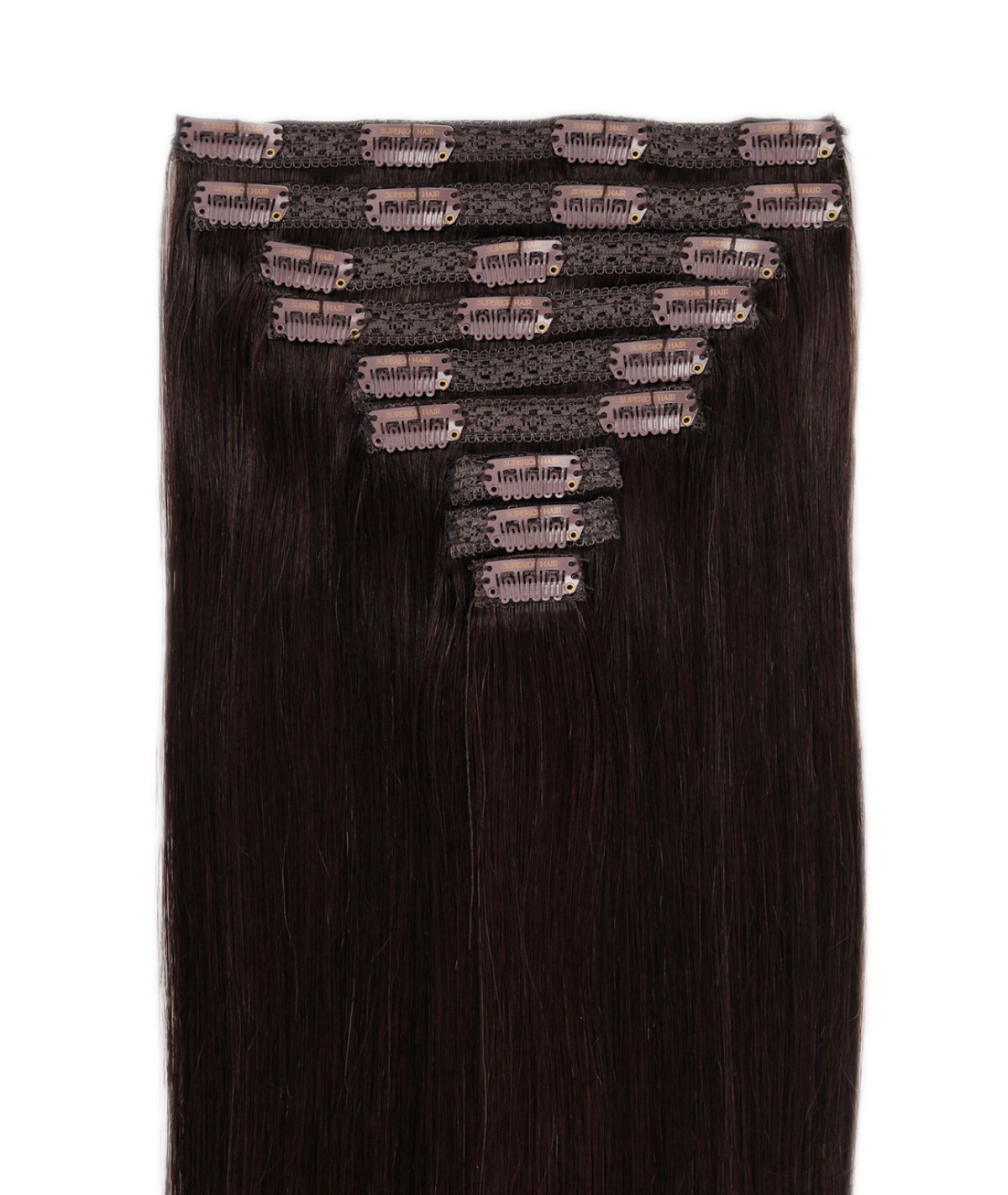

Traditional Machine Weft Hair Extensions: Still the Salon Workhorse
Quick answer
Machine weft hair extensions are a continuous machine-sewn track of Remy human hair that a stylist beads and stitches into the natural hair. Superior Hair's traditional weft comes in 20 inches, 50g, with a 50cm track. It sits for 4 to 6 weeks per application and can be reused up to three times.
Every few seasons a new bond type arrives and someone declares the traditional weft finished. It never quite happens. Machine weft hair extensions are still the method a lot of experienced stylists reach for when a client wants real density fast, and the reason is boring and practical: one track covers ground that sixty individual strands would take an afternoon to cover. This is a working look at where the machine weft still wins, where it genuinely loses to a newer line, and how to install and maintain it so it holds for the full cycle.
In this guide
Stocking wefts this season?
Superior Hair's traditional weft runs in over 30 colours, all 100% Remy human hair, all cut from the same premium grade as our professional lines.
Browse the traditional weft collection →What a machine weft actually is
A machine weft is a length of hair sewn into a continuous seam by machine rather than knotted by hand. That seam is the defining feature. It is stronger and more uniform than a hand-tied return, it will not unravel under normal handling, and it is also thicker, which is the tradeoff you carry into every consultation.
Superior Hair's traditional weft is supplied at 20 inches, 50g per bundle, with a 50cm width per track. One track is enough to cover a full row across most heads, and you cut to fit rather than building the row out of segments. The hair itself is 100% Remy, taken from our top premium virgin grade with the cuticles intact and running in one direction, which is what keeps a reused weft from matting at the mid-lengths in month three. If you want the detail on grading and cuticle alignment, it is set out on the Our Hair and Factory page.
Machine wefts are a professional-only method. They are secured with silicone-lined beads and traditional stitching, in whichever combination the client's hair calls for, and they are not a product a client can fit at home.
Why machine weft hair extensions are still the salon workhorse
Three things keep this method in rotation.
Coverage per unit of chair time. A full traditional weft install runs around 2 to 3 hours. Delivering the same weight in individual bonds means placing and clamping dozens of strands one at a time. For a client who wants obvious density rather than a few face-framing pieces, the weft is simply the faster route to the result.
Reuse economics. A machine weft can be reused up to three times, and with good aftercare a set will last up to a year. That changes the conversation at the consultation. The client is not repurchasing hair every move-up, they are paying for your time to refit hair they already own. Bonded methods get reused too, but a weft is one piece to clean, re-stitch and refit rather than 25 or 50 separate strands to re-tip.
Customisation. You control row placement, row count and track length. That is real design freedom for corrective work, for building weight through a heavy one-length cut, or for adding a single lower row on a client who only needs length at the back. Our rundown of permanent extension installation methods sets the weft alongside the bonded lines if you want the wider comparison.
Which clients suit machine wefts, and which do not

This is where honesty saves you a redo. Because the machine-sewn seam is larger than a hand-tied or tape base, the traditional weft is suited to medium and thick hair. In genuinely fine or sparse hair it can show, particularly at the crown, in a high ponytail, or in direct sun. Nothing about your row placement fixes a track that the client's own density cannot cover.
Good candidates are clients with medium to thick density who want length plus weight, who are comfortable with a salon maintenance cycle, and who wear their hair down or in low styles most of the time. Clients with fine, fragile or thinning hair are better served by a smaller base. The genius hand-tied weft gives you a far smaller track for thin to medium hair, and the Invisi Butterfly Weft sits on a flat tape-style base with butterfly holes that distribute weight across the beads, which reduces tension on finer sections.
Say that out loud in the consultation. A client who is told why she is being steered to a different weft trusts the recommendation far more than one who is sold the method you happen to have in stock.
The install: chair time, beads and tension

Book 2 to 3 hours for a full set and have the client arrive freshly washed with no product through the lengths or at the scalp. Residue at the root is the most common reason beads slip in week one.
The anchor row is built from silicone-lined micro beads set along a clean horizontal section, then the track is stitched to that row. Keep sections even and keep bead tension consistent: a bead clamped tight enough to feel secure in the chair is usually tight enough to ache by evening and to stress the follicle over six weeks. The weft should move when the client moves her head.
Placement rules that hold up across most heads: stay well below the occipital bone on the lowest row, leave a finger's width of natural hair above each row so the track has cover, keep rows clear of the temples and the nape hairline where hair is finest, and taper track length at the sides so the ends do not poke through in a half-up style. Seal or fold cut ends of the machine seam so the seam holds once you have trimmed to width.
Sharpen your weft work
Our training academy covers sew-in and bead technique, sectioning, tension control and move-ups, so you can add weft services with confidence and charge for them properly.
See the Hair Extension Training AcademyMachine weft vs genius weft, butterfly weft and tape-ins
The specs below are Superior Hair's own line data, so you can quote them straight to a client in the consultation.
| Method | Base and size | Install | Best suited to |
|---|---|---|---|
| Traditional machine weft | 20 inches, 50g, 50cm track | Beads plus stitching, 2 to 3 hours | Medium to thick hair wanting density |
| Genius weft | 20 inches 50g or 24 inches 60g, 80cm wide, very fine track | Sew-in, cuts anywhere on the seam without unravelling | Thin to medium hair, custom row work |
| Invisi Butterfly Weft | 20 inches 50g or 24 inches 60g, 36cm width, flat tape base | Silicone-lined microbeads only, around 15 minutes, no sewing | Fine or fragile hair, clients wanting a fast fit |
| Ultra seamless tape-in | 4cm wefts, 2.2g to 3.5g each, 10 wefts per pack | Sandwiched tape bonds, reusable up to four applications | Almost all hair types, least damaging option |
Read that table as a fitting tool rather than a ranking. The machine weft is not the most discreet option on the list and was never meant to be. It is the most robust, the most reusable per piece, and the quickest way to put serious weight into hair that can carry it. If your client is on the fence between sew-in styles, our piece on the genius weft explains the hand-tied difference in client-friendly language.
Colour matching and customising the track
The traditional weft runs in over 30 colours, including balayage and highlighted blends. Match in natural light against the mid-lengths and ends rather than the root, because that is where the weft will actually sit. If the client has a deliberate root shadow, match to the lengths and let her own regrowth carry the shade at the top.
For blended or dimensional colour, two shades in one row read more naturally than a single flat block, especially on a client who has lived-in balayage. Work from the traditional weft colour guide when you are ordering rather than matching from a screen, since monitors shift ash and gold badly.
One firm limit: do not bleach or lighten the hair. Extension hair has already been through a chemical process, and lifting it costs you the integrity that makes a weft worth reusing. If the shade is not there, order the shade rather than creating it.
Longevity, reuse and the aftercare that protects it
Plan on 4 to 6 weeks per application before a move-up. Beyond that the rows drop with natural growth, the tension changes, and matting risk at the bead line climbs. Book the next appointment while she is still in the chair, because a client who lets a weft run to eight or nine weeks is the client who arrives with tangling you now have to cut out.
Across those cycles the weft can be reused up to three times, and with proper care the set lasts up to a year. What protects that investment is home care, so send her away with the rules rather than hoping:
- Sulphate-free shampoo and alcohol-free styling products only.
- No conditioner at the roots or through the bonds, only mid-lengths and ends.
- Never brush wet hair, and use an extensions-friendly brush on dry hair.
- No daily washing. Dry shampoo between washes is fine.
- Argan oil is fine, coconut oil based products are not, as they loosen bonds.
- Heat protectant every time, and keep tools off the root area and the track itself.
- Braid loosely or tie back gently at night, and leave hair down for the first week after fitting.
Those seven lines are the difference between a set that comes back to you three times and a set the client replaces after one cycle and blames on the hair.
Stock Superior Hair wefts at trade pricing
Open a trade account to buy traditional wefts, genius wefts and butterfly wefts at professional rates, with free colour matching behind you.
Apply for a trade account →Frequently asked questions
How long do machine weft hair extensions last?
Each application sits for 4 to 6 weeks before a move-up is needed, as natural growth drops the rows away from the scalp. The hair itself can be reused up to three times, and with sulphate-free washing and correct brushing a set can last up to a year before replacement.
Are machine wefts suitable for fine hair?
Usually not. The machine-sewn seam is larger than a hand-tied or tape base, so it may be visible in thin hair at the crown or in a ponytail. Clients with fine or fragile hair are better matched to a genius hand-tied weft or an Invisi Butterfly Weft, both of which use a much smaller base.
How long does a full weft install take?
Allow 2 to 3 hours for a full traditional weft set. The client should arrive with freshly washed hair and no product through it, as residue at the root makes beads slip. Move-up appointments are shorter, since you are refitting existing hair rather than building rows from scratch.
Can a client install machine wefts at home?
No. Traditional wefts are a professional-only method, secured with silicone-lined beads and stitching that require correct sectioning and tension control. A home install risks traction damage and visible rows. Clients who want to fit their own hair should look at clip-in or halo options instead.
What size is a Superior Hair traditional weft?
The traditional machine weft is supplied at 20 inches in length, 50g per bundle, with a 50cm width per track, in over 30 colours. It is made from 100% Remy human hair from our premium virgin grade, with the cuticles intact and aligned in one direction.
Machine weft or tape-in for a first-time extensions client?
It depends on density. A first-timer with thick hair who wants noticeable weight will get there faster with a weft. A first-timer with average or finer hair is usually better in ultra seamless tape-ins, which use a 4cm weft at 2.2g to 3.5g each and are the least damaging semi-permanent option we carry.