When it comes to choosing a hair extension manufacturer for your salon, it’s not just about finding the best price or the most popular brand. Quality matters, and knowing how to spot a reliable manufacturer is key to ensuring your clients leave your chair feeling confident and fabulous. So, what should you look for in a manufacturer to guarantee high-quality hair extensions every time?
Let’s break down the essential factors, using the practices of Superior Hair Factory as a solid example of quality assurance done right.
Remy Hair Quality: The Gold Standard
One of the first things you should check is whether the manufacturer offers Remy hair. Remy hair means that the cuticles are intact and aligned in the same direction, resulting in silky smooth hair that’s tangle-free.
Why is this important? For your clients, Remy hair means a more natural look, longer-lasting extensions, and a better overall experience. It’s important for you, as a stylist, because Remy hair is easier to work with, style, and maintain. Extensions that use non-Remy hair might seem like a good deal upfront, but they can become a nightmare later on with tangling and matting. That’s why it’s worth checking if the manufacturer is transparent about offering authentic Remy hair.
For example, Superior Hair Factory proudly advertises that their hair is 100% genuine Remy human hair, which means their extensions can withstand styling, washing, and daily wear without losing quality. Always make sure the manufacturer can guarantee Remy hair—it’s the difference between happy, returning clients and frustration.
Factory Certifications: Proof of Quality Assurance
Another important factor when choosing a hair extension manufacturer is whether their factory is certified. Certifications indicate that the factory follows certain standards, whether it’s about quality control, ethical production, or ensuring the safety of workers. A manufacturer who goes the extra mile to get certified is likely more reliable and consistent in producing top-tier extensions.
A well-certified factory, like Superior Hair Factory, ensures that every weft, tape, and clip-in extension goes through strict quality checks. This gives you peace of mind that each batch will meet your salon’s standards. You want to partner with manufacturers who have strict quality control processes in place—this means fewer surprises and better consistency in the products you offer your clients.
Ethical Sourcing: Do You Know Where the Hair Comes From?
Your clients care more than ever about where the products they use come from, and that includes hair extensions. Ethical sourcing means the hair is obtained in a way that is respectful to the donors and doesn’t exploit people in the process.
An ethical manufacturer like Superior Hair Factory works closely with reputable hair suppliers who follow ethical sourcing practices. They also have long-standing relationships with the communities they source from, ensuring the donors are treated fairly. This kind of transparency is a huge plus, as it reassures your clients that they’re not unknowingly supporting unethical practices.
Before partnering with a hair extension manufacturer, ask about where their hair is sourced. Are they able to trace the origin of the hair? Ethical sourcing isn't just a trend; it's becoming an essential part of the beauty industry. Your clients will appreciate knowing that the hair they’re getting has been sourced responsibly.
Range of Products: Options Matter
When looking for a hair extension manufacturer, variety matters. Does the manufacturer offer a wide range of hair extension types, textures, and colours? Being able to offer clients different options allows you to cater to various hair types and personal preferences.
Superior Hair Factory has an extensive range of products from tape-ins to weft extensions, and they offer customisation options, too. This kind of variety is ideal for salons that cater to a diverse clientele. It allows you to be more flexible in your services and match the perfect extensions for your clients’ unique needs.
Communication & Support: Building a Partnership
Another important aspect when choosing a hair extension manufacturer is their customer service. Do they address your questions and concerns? Is immediate support provided if something goes wrong?
A reliable manufacturer will treat their relationship with you as a partnership, not just a transaction. Superior Hair Factory offers excellent support to their salon partners, making it easy to ask for help, track orders, or resolve any issues. A manufacturer that values open communication is one you can rely on for the long term.
Choosing the right hair extension manufacturer can make a huge difference in the success of your salon. From offering high-quality Remy hair to maintaining ethical sourcing practices and having strong factory certifications, there are several key factors to look out for.
By focusing on manufacturers like Superior Hair Factory, who prioritise quality and ethical standards, you ensure that your clients are getting the best products available. This leads to satisfied clients who trust your services and keep coming back for more! Remember, quality assurance is key—don’t settle for less when you and your clients deserve the best! Get started with a trusted partner for top-notch hair extensions. Contact Superior Hair Factory here today.
Classic Clip-In Hair Extensions NZ: A Beginner's Buyer Guide
Quick answer
Classic clip in hair extensions in NZ from Superior Hair are 9-piece sets of 100% Remy human hair, from 105g at 16 inches to 145g at 26 inches, made for thin to medium hair. You clip them in at home in minutes, take them out at night, and a well cared for set can last up to a year.
If you are buying clip in hair extensions in NZ for the first time, the choices pile up fast: classic or seamless, which length, which shade, and whether the cheaper set is worth it. Classic clip-ins are where most beginners start, because they add real length and volume with no salon appointment and no commitment. This guide walks through exactly what is in a set, who it suits, how to match your colour, and how to make it last.
In this guide
What are classic clip-in hair extensions?
Are clip-ins right for you? The pros and honest limits
Which clip in hair extensions in NZ suit your hair? Classic, seamless or value grade
Choosing your length and weight
How to get the colour right
How to put in clip-in extensions
Caring for your set so it lasts
Before you buy: tester piece, returns and shipping
FAQs
What are classic clip-in hair extensions?
Clip-in extensions are wefts of hair (strips of hair stitched to a fabric band) with small pressure clips sewn along the top. You open the clips, slide them into a section of your own hair close to the root, and snap them shut. Nothing is glued, taped or bonded, so you can wear them for a day and take them out that night.
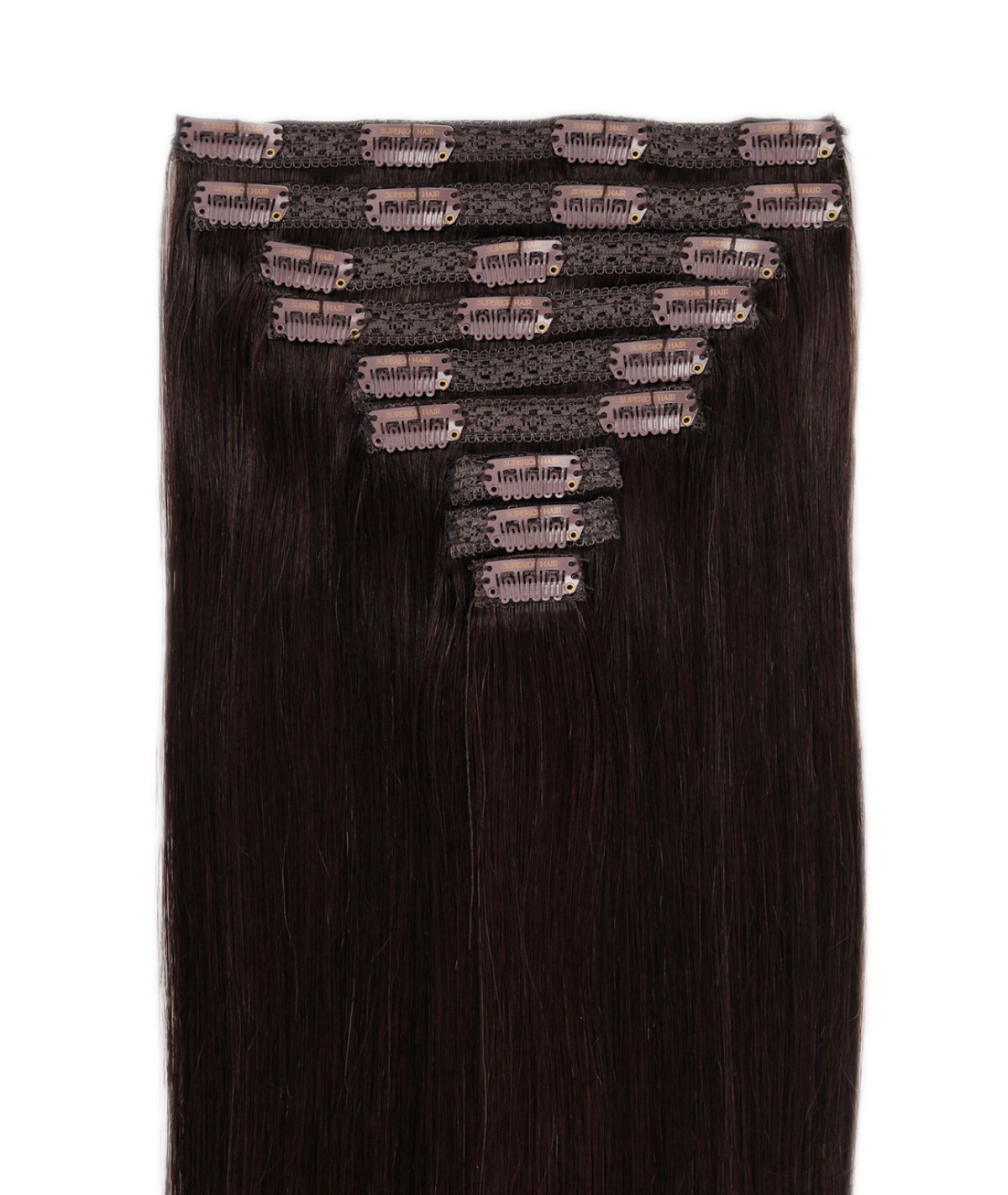
Superior Hair's classic set comes as 9 pieces in a range of widths. The widest weft goes across the back of your head, mid-width pieces build up the layers above it, and the smallest wefts sit above your ears to fill in around your face. Every set is AAA grade, 100% Remy human hair, which means the cuticle (the outer layer of each strand) is kept intact and runs in one direction from root to tip. That is what lets the hair stay smooth, resist tangling, and take heat styling like your own hair does.
New to extensions?
Clip-ins sit alongside halos and ponytails in the ready-to-wear range: hair you put on and take off yourself, with no salon visit.
See all ready-to-wear extensions →
Are clip-ins right for you? The pros and honest limits
Where clip-ins shine
No commitment. Wear them for a wedding, a ball, a birthday or a big night out, then put them back in the box.
No appointments. There are no salon move-ups or removal visits, which keeps the ongoing cost low.
Your hair gets a rest. Because they come out every night, your natural hair is not carrying weight around the clock.
Reusable. You can wear the same set as many times as you like, and with good care it can last up to a year.
Where they are not the best fit
Clip-ins are not for sleeping, swimming or the gym, and they take a few minutes every time you want to wear them. If you want extensions in every day without thinking about it, a semi-permanent method fitted by a stylist will probably suit you better. Our comparison of clip-in vs tape-in hair extensions sets out that trade-off in detail.
Clip-ins also need enough of your own hair to hide the clips and blend over the wefts. Very short or very fine hair can still wear them, but it takes more careful placement and possibly a lighter set.
Which clip in hair extensions in NZ suit your hair? Classic, seamless or value grade
Superior Hair sells several clip-in lines in New Zealand. The right one mostly depends on how much hair you have to start with.
Set
Pieces
Weight by length
Best for
Classic clip-in (AAA grade)
9
16in 105g, 20in 125g, 22in 125g, 26in 145g
Thin to medium hair
Seamless clip-in
10
16in 160g, 20in 180g, 24in 240g
Medium to thick hair
Value grade classic clip-in (AA to AAA grade)
9
Same weights as the classic set
Occasional wear, events, first-timers
Classic is the all-rounder. Its weights are matched to thin and medium hair, so the extensions blend in rather than sitting as a thick layer under your own hair.
Seamless is the step up for denser hair. Each weft has more hair attached to a slim silicone strip, so if a classic set would look thin against your natural hair, the seamless clip-in extensions are the better buy.
Value grade is previous-generation ready-to-wear stock, moved across as newer AAA hair comes in. The value grade classic clip-ins are still 100% Remy human hair, but Superior Hair notes the texture may be slightly coarser, with more natural variation and a shorter lifespan than current stock. They are a sensible choice if you want to try extensions for an event or two. Keep in mind that value grade products are final sale.
Choosing your length and weight
Classic clip-ins come in 16, 20, 22 and 26 inches. Notice how the weight climbs with length, from 105g to 145g. Longer hair needs more grams to keep the ends looking full rather than wispy, so the longer sets carry more hair to match.
A few rules of thumb help beginners pick well:
Start a realistic step longer than your own hair. The bigger the jump in length, the harder it is to blend where your hair ends and the extensions carry on.
Measure from the nape, not the crown. Extension length is the length of the weft hair itself, and the lowest weft sits near the nape.
Think about how you wear it. A 20-inch set is easy to style day to day. A 26-inch set is a statement, and the extra length is more to manage.
The hair length guide shows where each length falls on the body, which makes it much easier to picture the finished result.
How to get the colour right
Colour is the difference between extensions that disappear into your hair and extensions that look like extensions. Classic clip-ins come in 30+ colours (some lengths have a smaller range), including solid shades, highlights, balayage, ombre and rooted blends.
Match your mid-lengths and ends, not your roots. Your roots are often a different shade from the rest of your hair, especially if you colour it. The extensions sit underneath and blend into the lengths, so that is the colour that counts.
Use a blended shade if your hair has dimension. If your hair is highlighted or grown-out balayage, a single solid shade can look flat against it. A highlight or balayage shade picks up the variation in your own colour.
Check in natural light. Indoor lighting and phone filters shift colour. Superior Hair offers a free photo colour match: send a front and back photo in natural light with no filters, and the team will recommend a shade. If you would rather compare shades in person, a colour ring from the colour rings and swatches range holds sixty sample pieces you can hold against your hair at home.
Not sure of your shade?
The classic clip-in colour guide shows every shade in the range, with tips on photographing your hair for an accurate match.
View the classic clip-in colour guide
How to put in clip-in extensions
Anyone can fit classic clip-ins at home, and it gets quick after the first few goes.
Brush out any tangles in your own hair first.
Section a clean line at the back of your head, a little above the nape, and clip the rest of your hair up out of the way.
Place the widest weft along that line and press each clip shut close to the root. A light backcomb at the root gives the clips extra grip, especially in fine or silky hair.
Work your way up, dropping a new section of hair each time and adding the next weft above.
Finish with the smallest wefts above your ears for body around your face. Keep them back far enough that the clips stay covered.
Let your hair down and brush gently with a loop or extensions-safe brush to blend the layers.
You do not have to use all nine pieces every time. For a little volume, the wider back wefts on their own often do the job. Our beginner's starter guide to hair extensions covers more first-timer tips.
Caring for your set so it lasts
Clip-in hair is not attached to your scalp, so it does not get your natural oils. How you treat it decides whether a set lasts a few months or up to a year.
Wash sparingly. Clip-ins only need washing every 10 to 15 wears. Use dry shampoo made for extensions in between.
Use sulphate-free, alcohol-free products, and skip shampoos made for volume or coloured hair.
Brush dry, never wet, starting at the ends and working up.
Style with heat protectant. Curl, straighten and tone them like your own hair, but keep hot tools off the weft band and clips.
Never sleep or swim in them. Both tangle the hair and strain the clips.
Do not bleach, lighten or dye them. The hair has already been coloured to its shade.
Store them dry, flat and out of the sun, in a box or case between wears.
The full hair care guide walks through washing step by step, along with sunscreen and swimming tips for the NZ summer.
Before you buy: tester piece, returns and shipping
Every classic clip-in set includes a small tester weft packed on top of the box. Use it to check the colour against your hair before you open the main pack, because Superior Hair accepts returns and exchanges within 30 days only if the product is unopened, unworn and the seal is intact. If you return a set, include the tester piece too.
Orders placed before 2pm on weekdays ship the same day, which helps if you are buying for an event. Value grade sets are the exception on returns: they are final sale, so confirm your shade before ordering one.
Ready to try your first set?
Classic clip-ins come in four lengths and 30+ shades of 100% Remy human hair.
Shop classic clip-in extensions →
FAQs
What are the best clip in hair extensions in NZ for beginners?
For most beginners, a classic clip-in set is the easiest start. Superior Hair's classic set is 9 pieces of AAA grade, 100% Remy human hair, made for thin to medium hair, and goes in at home in minutes. If your hair is thick, choose the seamless set instead, which carries more hair per weft.
How long do classic clip-in extensions last?
A classic clip-in set can be reused as many times as you like and can last up to a year with good care. Wash only every 10 to 15 wears, use sulphate-free and alcohol-free products, brush the hair dry, and never sleep or swim in your extensions.
Do I need one set or two?
One set covers a full head. The classic set is weighted for thin to medium hair, from 105g at 16 inches to 145g at 26 inches. If one classic set looks thin against your natural hair, switch to the seamless set, which runs from 160g to 240g, rather than buying two classic sets.
Can I curl and straighten clip-in extensions?
Yes. Superior Hair clip-ins are 100% Remy human hair, so you can curl, straighten and blow-dry them like your own hair. Always use a heat protectant, and keep hot tools away from the weft band and clips. Do not bleach, lighten or dye them, because the hair is already coloured to its shade.
How do I choose the right shade?
Match the mid-lengths and ends of your hair, not your roots. If your hair has highlights or balayage, choose a blended shade. Superior Hair offers a free photo colour match using front and back photos in natural light, and every classic set includes a tester weft so you can check the colour before opening the pack.
Do Hair Extensions Damage Your Hair? An Honest Answer
Quick answer
Hair extensions do not damage your hair when they suit your hair type, are fitted correctly and are maintained on time. Damage comes from too much weight or tension, overdue maintenance, DIY removal, heat on the bonds and the wrong products. Choose the right method, keep your appointments and follow the aftercare.
Do hair extensions damage your hair? It is the question we hear most often in the salon, usually from someone who had a bad experience years ago or has seen a horror story online. The honest answer is that extensions can damage hair, but they rarely do it on their own. Almost every case of damage traces back to a handful of avoidable mistakes, and this guide walks through each one so you know exactly what to look for.
In this guide
Do hair extensions damage your hair? The short answer
What actually causes extension damage
Which extension methods are gentlest?
Why the hair itself matters: Remy vs non-Remy
Is your hair a good candidate for extensions?
Aftercare that protects your own hair
Maintenance and removal: where most damage happens
Warning signs to watch for
FAQs
Do hair extensions damage your hair? The short answer
No, not when they are done properly. Extensions are attached to your natural hair, so they will always ask something of it: some extra weight, a bond near the root, a bit more care. Healthy hair handles that comfortably. Problems start when the ask is too big for the hair underneath, or when the care stops.
Think of it like wearing a backpack. A light, well-fitted one sits comfortably all day. Overload it, or wear it with one strap twisted for months, and something starts to hurt. Extensions work the same way, which is why the method, the amount of hair and the upkeep matter more than whether you wear extensions at all.
Want no bonds at all?
A halo sits on an invisible wire around your crown, with nothing attached to your hair. It goes on in under a minute and comes off the same way.
Explore halo extensions →
What actually causes extension damage
When we see damage, it nearly always comes from one of these five causes.
1. Too much weight or tension for your hair
Every bond, bead or clip puts some pull on the strands it is attached to. If the section of natural hair is too small for the extension it carries, or there is simply too much extension hair for your density, those strands are under constant strain. Over months, that tension at the root is the main way extensions cause breakage and thinning.
2. Overdue maintenance
Your hair grows, and the bonds grow out with it. As they drop further from the scalp, the hair between the bond and the root starts to twist and knot, and the bond swings with more leverage. Leave it too long and that new growth can mat, which is much harder to undo without losing hair.
3. DIY removal
Peeling off tapes, prising open beads or cracking keratin bonds at home is the fastest way to snap your own hair. Semi-permanent bonds are designed to be released with the right remover and technique.
4. Heat and the wrong products near the bonds
Hot tools held on the bonds can loosen tape adhesive and keratin, so the extension slips and pulls. Conditioner, oils and heavy products at the root do the same. Coconut oil-based products are a particular problem for bonded methods.
5. Rough handling day to day
Brushing wet hair, towel-rubbing, sleeping with hair loose, or tying it up tightly in the first week after a fit all add strain at the root. None of it seems like much on the day, but it adds up across a whole application.
Which extension methods are gentlest?
Every method has its own risk profile. The gentlest method is the one that suits your hair, not one that is gentle in general. Here is how Superior Hair's main methods compare.
Method
How it attaches
Main damage risk
Upkeep
Halo
Wire around the crown, no attachment
Very low
Remove daily
Clip-in
Clips on wefts, worn by the day
Clip strain if worn overnight or every day
Remove before bed
Ultra seamless tape-in
Thin section sandwiched between two tape wefts
Slipping from oils or conditioner at the root
Salon maintenance every 5 to 8 weeks
Nano tip
Strand clamped in a silicone-lined bead
Tangling at the root if maintenance slips
Salon maintenance every 5 to 8 weeks
Hot fusion U-tip
Keratin bond melted onto the strand
Breakage from incorrect removal
Professional removal after 8 to 12 weeks
Genius and butterfly wefts
Weft secured with silicone beads (genius also sewn)
Weight on one row if it is too heavy for the hair
Salon maintenance every 4 to 6 weeks
Superior Hair describes its ultra seamless tape-in extensions as the least damaging semi-permanent option, because the small, flat bond spreads weight across a wide section. Nano tip extensions use no heat or glue, and the silicone lining inside each bead protects the hair it grips. U-tips are popular for longer wear between appointments, but the keratin bond means removal has to be done carefully by a stylist.
Why the hair itself matters: Remy vs non-Remy
The quality of the extension hair affects your own hair more than people expect. The outer layer of every hair strand, the cuticle, is made of tiny overlapping scales. In Remy hair those scales are kept intact and all run the same direction, root to tip, so strands slide past each other instead of catching.
Lower-grade hair is often stripped of its cuticle in an acid bath to make it feel soft in the packet. It feels fine at first, then dries out, tangles and mats. Tangled extension hair knots into your natural hair, and every brush through it pulls at the bonds. As Superior Hair explains on its page about its hair, its 100% Remy human hair is processed without acid treatments so the cuticle stays in place. That is not a vanity point. Smooth, cuticle-intact hair is simply kinder to wear.
Protect your hair and your set
The right brush, the right shampoo and a sensible wash routine do more to prevent damage than anything else you control at home.
Read the hair care guide
Is your hair a good candidate for extensions?
Most people can wear extensions safely, but the right method changes with your hair.
Fine or fragile hair needs lightweight methods, smaller bonds and less total hair. A heavy full head is exactly the setup that leads to breakage. Our guide to the best extension methods for fine and fragile hair covers which options spread weight best.
Thinning hair often does better with targeted coverage than a full set. Scalp fill-ins clip in around the part or crown for cosmetic coverage, without bonds across the whole head. They will not change what your own hair is doing, so if you have noticed sudden or patchy loss, see a doctor first to understand the cause.
Healthy, medium to thick hair can take most methods. The bigger risk here is under-maintenance, because dense hair tangles faster around bonds as it grows.
If your hair is already breaking, very dry or recently over-processed, it is worth giving it time to recover before adding a semi-permanent set.
Aftercare that protects your own hair
These habits come straight from Superior Hair's care instructions, and each one takes pressure off your natural hair.
Brush dry, never wet. Start at the ends and work up, holding the hair near the bonds. A loop-style detangling brush glides past bonds and wefts instead of catching them.
Keep conditioner and oils off the bonds. Condition mids and ends only. Avoid coconut oil-based products on bonded methods; argan oil products are fine.
Wash less, and gently. Do not wash semi-permanent extensions daily. Use a sulphate-free, alcohol-free shampoo, and dry shampoo in between.
Pat, do not rub. Towel-rubbing pulls at every attachment point.
Braid or loosely tie hair for bed with bonded methods, and always take clip-ins and ponytails out before sleeping.
Keep heat off the roots. Use a heat protectant on lengths and keep hot tools away from bonds and clips.
Go easy in the first week. Avoid tight ponytails and updos straight after a fit while your roots adjust.
Skip swimming in your extensions. Chlorine and salt water dry the hair and loosen bonds.
Maintenance and removal: where most damage happens
If there is one thing to take from this article, it is this: keep your maintenance appointments. At Superior Hair's Auckland salon, tape-ins and nano tips are maintained every 5 to 8 weeks, wefts every 4 to 6 weeks, and U-tips are removed after 8 to 12 weeks. Pushing past those windows is how growing-out hair starts to knot at the root.
Removal should always be done by a stylist using the right product for the method. Tape bonds are released with a remover so the tape lets go cleanly, beads are opened with the correct tool, and keratin bonds are broken down rather than pulled. Done properly, removal should not take more of your hair than you would naturally lose.
One thing that alarms people is the amount of hair that comes out at removal. Everyone sheds some hair every day. With bonded methods, shed hairs stay trapped near the bond instead of falling out, so weeks of normal shedding appear all at once. That is usually not damage, though your stylist can tell you if something looks off. Good care also makes reusable sets last longer, which our article on how long hair extensions last explains method by method.
Warning signs to watch for
Book in with your stylist early if you notice any of these:
Soreness, tightness or tenderness at the scalp that lasts beyond the first few days.
Bonds or wefts slipping, or a bond hanging by just a few strands.
Knots or matting forming at the root between appointments.
Broken, short hairs around the hairline or where bonds sit.
Patches of thinning along the hairline or part.
Most of these are fixed by adjusting placement, reducing weight or moving to a lighter method. If thinning continues after the extensions come out, or appears suddenly, see a doctor.
Start with the right method for your hair
A free consultation matches the method, weight and placement to your hair before anything is fitted.
Book a free consultation →
FAQs
Do hair extensions damage your hair?
Not when they are the right method for your hair, fitted correctly and maintained on time. Damage comes from too much weight or tension, overdue maintenance, removing bonds at home, heat on the bonds and the wrong products. Choosing a suitable method and keeping your salon appointments prevents almost all of it.
Which hair extensions are the least damaging?
Halos attach nothing to your hair, so they carry the least risk. Among semi-permanent methods, Superior Hair describes ultra seamless tape-ins as the least damaging because their flat bond spreads weight. Nano tips also use no heat or glue. The gentlest option is always the one that suits your hair density.
Do clip-in extensions damage your hair?
Clip-ins are low risk when worn for the day and taken out at night. Problems come from sleeping or swimming in them, wearing them every day without a break, or clipping onto very fine sections. Brush them dry, keep hot tools away from the clips, and place each clip on a solid section of hair.
Why does so much hair come out when extensions are removed?
Everyone sheds some hair daily. With bonded methods, those shed hairs stay trapped near the bond instead of falling out, so several weeks of normal shedding appear at once during removal. That is usually not damage. Short broken hairs or thin patches are different, so ask your stylist to check if you see those.
Can I wear extensions if I have thin hair?
Yes, with the right method and less total hair. Fine hair suits lightweight options with small bonds, placed on generous sections. For thinning at the part or crown, scalp fill-ins give cosmetic coverage without bonds. If your hair loss is sudden or patchy, see a doctor before adding extensions.
How Many Packs of Hair Extensions Do I Need?
Quick answer
How many packs of hair extensions you need depends on the method, your hair density and your target length. One clip-in set covers a full head. Strand methods like U-tips and nano tips usually take four to six packs, genius wefts two to four, and tape-ins are set by grams at consultation.
Working out how many packs of hair extensions to buy is the question that trips up almost everyone, because a "pack" means something different for every method. A clip-in set is a whole head of hair in one box, while a pack of nano tips is 25 single strands. Get the count wrong and you either end up with see-through ends or a heavy, bulky result. This guide breaks it down method by method, using Superior Hair's actual pack sizes, so you can buy with confidence.
In this guide
What decides how many packs you need?
What is in a pack? Superior Hair pack sizes by method
A simple way to work out your pack count
How many packs of clip-in extensions do you need?
How many packs of tape-ins, nano tips and U-tips?
How many packs of weft extensions?
Fine, thick and short hair: adjusting the count
When one more pack makes sense, and when it doesn't
FAQs
What decides how many packs of hair extensions you need?
Four things set your number, and they matter in roughly this order.
Your natural density. Density is how many strands grow from your scalp, not how thick each strand is. Someone with dense hair needs more extension hair to match it from root to tip, otherwise the extensions show as a thin curtain under a thick top layer. Someone with fine, sparse hair needs less, and actually has to be careful not to overload their own hair.
The length you are adding. The further the extensions sit past your natural length, the more hair it takes to keep the ends looking full. Short hair going to 22 inches needs more packs than shoulder-length hair going to 18 inches, because there is less of your own hair to blend into below the cut line.
Your goal: length, volume or both. Volume only, such as filling a thin crown or adding body through the sides, can take a fraction of a full head. Length plus volume is a full application.
The method. This is the one that changes the unit. Clip-ins and halos are sold as complete sets. Tape-ins come in packs of wefts, strand methods in packs of individual strands, and sew-in or bead wefts as one long weft per pack. So "four packs" can mean a lot of hair or very little depending on what is in the box.
New to extensions?
Ready-to-wear methods come as complete sets, so there is no pack maths at all. Clip them in at home and take them out at night.
Browse ready-to-wear extensions →
What is in a pack? Superior Hair pack sizes by method
Before you can count packs, you need to know what one pack holds. Every Superior Hair range is 100% Remy human hair, with the cuticle kept intact and running in one direction, so packs of the same length and line blend together cleanly. Here is what you get per pack, taken from each product line.
Method
What is in one pack
Weight per pack
Typical full head
Classic clip-in
9-piece set
105g (16in) to 145g (26in)
1 set (thin to medium hair)
Seamless clip-in
10-piece set
160g (16in) to 240g (24in)
1 set (medium to thick hair)
Classic halo
Halo piece plus 2 clip-in wefts
140g (16in) or 180g (20in)
1 set
Ultra seamless tape-in
10 wefts (5 sandwiches), 4cm wide
22g (14in) to 35g (26in)
Set by grams at consultation
Nano tip / hot fusion U-tip
25 strands
About 25g (18in and 22in)
4 to 6 packs
Genius weft
One 80cm weft
50g (20in) or 60g (24in)
2 to 4 packs
Invisi butterfly weft
One 36cm weft
50g (20in) or 60g (24in)
Set by grams, about 3 to 4
Read the last column as a starting range, not a prescription. Your stylist will always confirm the final number once they have seen your hair in person.
A simple way to work out your pack count
The cleanest way to compare methods is to stop counting packs and start counting grams. Grams of hair are what actually create fullness, whatever the attachment.
A useful benchmark is a full clip-in set, because that is designed to give a full head on its own. At 20 inches, Superior Hair's classic set is 125g and is made for thin to medium hair, while the seamless set is 180g and is built for medium to thick hair. So a full head at around 20 inches sits somewhere in that 125g to 180g range, depending on density.
From there the maths is simple: target grams divided by grams per pack, rounded up.
18-inch tape-ins at 28g a pack, for medium hair aiming at about 125g: 125 divided by 28 is 4.5, so plan on five packs.
The same tape-ins for thicker hair aiming at about 180g: 180 divided by 28 is 6.4, so plan on six to seven packs.
20-inch butterfly wefts at 50g a pack: 125g to 180g works out to roughly three to four packs.
Treat this as an estimate for budgeting, not a quote. Semi-permanent hair is spread across many small bonds rather than a few clip-in rows, so a stylist may land slightly under or over depending on where your hair needs it most.
How many packs of clip-in extensions do you need?
For clip-ins the answer is usually just one set. Each set is built as a complete head, so the choice is which set, not how many.
Classic clip-ins
The classic clip-in extensions come as a 9-piece set and are made for thin to medium hair. Weight rises with length, from 105g at 16 inches to 145g at 26 inches, so the longer set keeps the ends from going wispy.
Seamless clip-ins
If your hair is medium to thick, a classic set can look thin next to your own hair. The seamless clip-in range packs more hair onto each silicone weft, 160g to 240g across 10 pieces, so one set matches a denser head without needing a second.
Halos, ponytails and fill-ins
A classic halo is one set: the main halo piece plus two clip-in wefts to blend the sides. A ponytail extension is one piece. For thinning at the part line or crown, scalp fill-ins come four small wefts to a pack, which is often enough on its own for targeted coverage, and they can be worn alongside a clip-in set.
Buying more than one shade?
Blending two shades changes your pack count, because you buy packs in each colour. Get your shades confirmed before you work out the numbers.
Get your colour matched
How many packs of tape-ins, nano tips and U-tips?
These are semi-permanent methods, installed by a trained stylist rather than at home, so your stylist sets the final count. It still helps to know the range before your appointment.
Tape-in extensions
Each pack of ultra seamless tape-in extensions holds 10 wefts, which makes five sandwiches (one weft above a thin section of your hair, one below). Pack weight runs from 22g at 14 inches to 35g at 26 inches. Using the gram method above, a medium-density head at 18 inches works out to about five packs, and thicker hair needs more. Ultra seamless tape-ins last 8 to 10 weeks before they are moved up, and the same hair is retaped, so you are not buying a new pack count every appointment.
Nano tips and hot fusion U-tips
Both come 25 strands to a pack at about 1g per strand (the 14-inch nano tips are slightly lighter at 0.8g). A full head commonly works out to four to six packs, so 100 to 150 strands, depending on density and the length you are matching. Nano tips are reusable as long as they are cared for. U-tips are bonded with keratin, last up to three months, and cannot be reused, so budget for a fresh pack count at each full reapplication.
How many packs of weft extensions?
Weft packs are the most generous, because each one is a long, continuous weft rather than lots of small pieces.
Genius weft: one 80cm weft per pack, at 50g for 20 inches or 60g for 24 inches. Most people use between two and four packs, and because the seam can be cut anywhere without unravelling, your stylist can split a pack into rows sized to your head.
Invisi butterfly weft: one 36cm weft per pack at the same 50g or 60g. By the gram method, that is roughly three to four packs for a full head at 20 inches, and fewer for fine hair. Each install lasts 4 to 6 weeks and the hair can be reused at least three times.
Traditional machine weft: 50g and 50cm per pack at 20 inches. The seam is larger, so it suits medium to thick hair, and the same gram logic applies.
Fine, thick and short hair: adjusting the count
Fine or thin hair
More is not better here. Every bond or clip puts some weight on your own hair at the root, and fine hair has fewer strands to share it. Sit at the low end of each range, choose lightweight methods with small bonds, and consider a volume-only application placed where you are thinnest. Our guide to the best hair extensions for thin hair goes through which methods are gentlest.
Thick or coarse hair
Dense hair is where under-buying shows. If you stop short, the extensions look like a thin layer hanging below your own hair. Plan for the top of each range, and for clip-ins start with the seamless set. Our article on extensions for thick and coarse hair covers how to add density without bulk.
Short hair
The bigger the jump in length, the more hair it takes to hide the line where your hair ends. Check the hair length guide to see where each length falls on the body, and choose a length that is realistic for blending rather than the longest available.
When one more pack makes sense, and when it doesn't
An extra pack is worth it if you have dense hair and are adding real length, if you are blending two shades and need enough of each to place them naturally, or if your stylist wants spare hair for face-framing pieces.
It is not worth it if your hair is fine and already struggling, if you only want volume rather than a full transformation, or if you are buying "just in case" in a shade you have not matched yet. Check your colour match before opening anything, because a sealed pack is the easiest one to sort out.
The most reliable number always comes from someone looking at your hair. Your density, length and goal are easy to describe, but much easier to judge in person or on camera.
Not sure of your number? Ask us.
A virtual consultation confirms your method, shade and pack count before you spend a cent.
Book a virtual consultation →
FAQs
How many packs of hair extensions do I need for a full head?
It depends on the method. A clip-in or halo set is one complete head. Nano tips and U-tips usually take four to six packs of 25 strands. Genius wefts take two to four packs. Tape-ins are worked out by grams, and a medium-density head at 18 inches works out to about five packs, with thicker hair needing more.
How many packs of tape-in extensions do I need?
Each Superior Hair ultra seamless tape-in pack has 10 wefts weighing 22g to 35g depending on length. At 18 inches, a medium-density full head works out to about five packs, while thick hair may need six to seven. Fine hair often needs fewer. Your stylist confirms the final count at consultation.
Is one set of clip-in extensions enough?
For most people, yes. Superior Hair clip-in sets are built as a full head. The classic set suits thin to medium hair, and the seamless set carries more hair per weft for medium to thick hair. If a classic set looks thin against your own hair, switch to the seamless set rather than doubling up.
How many grams of hair extensions do I need?
A full clip-in set is a good guide. At 20 inches, Superior Hair's classic set is 125g for thin to medium hair and the seamless set is 180g for medium to thick hair. Divide your target grams by the weight of one pack in your chosen method and round up to estimate packs.
Do I need more packs for longer extensions?
Usually, yes. Longer hair needs more grams to keep the ends looking full, and the bigger the gap between your natural length and the extensions, the more hair it takes to blend. Longer packs are heavier, so the count does not always rise much, but the total weight does.
Hair Extensions for Active Lifestyles: The Best Methods if You Swim, Train or Work Out Daily
Quick answer
The best hair extensions for active lifestyles are stylist-fitted nano tips and ultra seamless tape-ins, because they stay put through sweat, swimming and frequent washing without daily removal. Nano tips suit regular swimmers best, as there is no adhesive to soften. Clip-ins and ponytails work well if you take them out before training.
Choosing hair extensions for active lifestyles is less about which method looks best on day one and more about which one still looks good after your fortieth spin class and third swim of the week. Sweat, chlorine, salt water and friction all test extensions in different ways. This guide walks through what each method can handle, where each one struggles, and the care routine that keeps your set going for months rather than weeks.
In this guide
What sweat, chlorine and training actually do to extensions
The best hair extensions for active lifestyles, compared
Nano tips: the strongest pick for swimmers
Tape-ins: comfortable and flat under helmets and caps
Wefts and U-tips: when they suit an active routine
Clip-ins and ponytails: take them off for training
A swim, sweat and recovery care routine
Is your hair ready for semi-permanent extensions?
Frequently asked questions
What sweat, chlorine and training actually do to extensions
Extension hair is real hair, but it gets no natural oils from your scalp, so anything that dries it out stays dry until you put moisture back in.
Sweat sits at the attachment point
Sweat collects at the root, which is exactly where tapes, beads and bonds sit. Salt and oils left there build up over time, and on adhesive methods that build-up can loosen the grip. A quick rinse after training does more for your extensions than a heavy wash once a week.
Chlorine and salt water strip moisture
Pool chemicals and sea water pull moisture out of the hair shaft, and lighter shades can pick up a dull or brassy cast from minerals in the water. Blonde and pastel extensions show it first.
Friction and tension do the rest
A tight high ponytail, a bike helmet strap or a rowing machine headrest all rub and pull. Friction tangles the mid-lengths, and constant tension at the root stresses your own hair under each attachment. This is why hair quality matters: Superior Hair uses 100% Remy human hair with the cuticles all running in one direction, which tangles far less than non-Remy hair when it gets wet, sweaty and tossed around.
Training most days?
Semi-permanent methods stay in through workouts, swims and showers, so there is nothing to take out and put back in. Have a look at the full range before you choose a method.
Browse semi-permanent hair extensions →
The best hair extensions for active lifestyles, compared
Here is how each method holds up to a routine that involves a lot of sweat and water. Maintenance intervals are the in-salon guides Superior Hair gives for its Auckland salon; your stylist may adjust them for your hair.
Method
Maintenance
Swimming
Heavy sweat
Best for
Nano tips
Every 5 to 8 weeks
Very good (no adhesive)
Very good
Regular swimmers, high ponytails
Ultra seamless tape-ins
Every 5 to 8 weeks
Good with care
Good if rinsed
Gym, cycling, flat under helmets
Genius and butterfly wefts
Every 4 to 6 weeks
Good, slower to dry
Good
Thicker hair wanting lots of volume
Hot fusion U-tips
Removed after 8 to 12 weeks
Good
Good
Medium to thick hair, shorter commitment
Clip-ins, halos, ponytails
None, wash every 15 to 20 wears
Remove first
Remove first
Events and weekends, not workouts
Nano tips: the strongest pick for swimmers
Nano tips are individual strands, each attached to a small section of your own hair with a tiny bead that is clamped closed. There is no glue and no heat, so chlorine, sea water and sweat have no adhesive to break down. For anyone in the pool three or more times a week, that is the deciding factor.
Because each strand moves independently, nano tips also handle high ponytails and buns well. Your stylist can place them so the beads sit hidden even when your hair is pulled right up for training. Superior Hair's nano tip extensions come in packs of 25 strands, at about 1g per strand in the 18 and 22 inch lengths, and can be reused for up to three applications.
The tradeoffs: installation takes two to three hours in the salon, and the beads can feel noticeable for the first few nights until you get used to them. If you want the full breakdown of how bead methods are fitted and moved up, the complete guide to nano tip and bead methods covers it step by step.
Tape-ins: comfortable and flat under helmets and caps
Tape-ins are thin wefts that sandwich a slice of your own hair between two adhesive tabs. They lie completely flat against the head, which makes them the most comfortable option under a cycling helmet, a swim cap or a cap on a long run. A full head takes about an hour to fit, the quickest of the professional methods.
The catch for active people is the adhesive. Sweat, oils and heavy conditioner at the root can soften the bond over time, so tape-ins reward a disciplined routine: keep oil-based products away from the tapes, rinse sweat out the same day, and dry the root area properly rather than leaving it damp under a ponytail. Daily swimmers can wear tapes, but they usually see more slippage between appointments than they would with nano tips.
Ultra seamless tape-in extensions come in packs of 10 wefts and can be re-taped for up to four applications, which keeps the cost per month down if you look after them.
Not sure of your shade?
Sun and pool water shift your natural colour over a season, so a good match matters even more for active wearers. Send a photo and let the team match your shade and blend before you commit to a method.
Get your free colour match
Wefts and U-tips: when they suit an active routine
Genius and butterfly wefts
Weft methods attach a long, fine track of hair along a row of beads, sometimes with a sewn base. They give a lot of volume quickly and spread the weight evenly, which suits thick hair and people who want real fullness. Genius wefts are thin enough to cut to any width without unravelling, so they sit flatter than a traditional machine weft.
For sport, the main thing to know is drying time. A full row of weft holds more water at the root than individual strands do, and leaving that damp after a swim is how you get matting and smells at the attachment line. If you can commit to drying the root properly every time, wefts work well. Maintenance comes round more often, every 4 to 6 weeks.
Hot fusion U-tips
U-tips are bonded with keratin that your stylist melts around a small section of hair. The bond is strong and handles water and sweat well, but it is single use: the strands are removed after 8 to 12 weeks and cannot be refitted. They suit medium to thick hair and people who want a shorter commitment.
Clip-ins and ponytails: take them off for training
Clip-ins, halos and clip-in ponytails are the most hair-friendly option because nothing stays on your head overnight. For an active person, though, they are a style for after the workout, not during it. Running, lifting or swimming in clips loosens them, the grips can pull on your natural hair, and pool water goes straight into hair that does not get the scalp's oils.
They suit someone who trains hard on weekdays and wants length and volume for the weekend. A set of ponytail extensions is a quick way to get a sleek, full pony for a game day or a post-match dinner without any salon commitment, and ready-to-wear sets only need washing every 15 to 20 wears.
If you have fine hair and worry about any method putting strain on it, the guide to the best extension methods for fine and fragile hair is worth reading before you book anything semi-permanent.
A swim, sweat and recovery care routine
The routine decides whether your set lasts. Most of Superior Hair's reusable semi-permanent methods last 6 to 12 months with good home care, and active wearers are the ones most likely to land at the short end of that if they skip these steps.
Before you swim
Wet your hair with fresh water first. Hair that is already full of clean water soaks up less chlorine or salt.
Wear a swim cap for laps, and braid long lengths loosely underneath so they do not knot.
Use a mineral sunscreen with zinc oxide or titanium dioxide for outdoor swims, and tie your hair back while you apply it. Superior Hair's care guide notes that avobenzone and oxybenzone can stain extension hair.
After every swim or session
Rinse with fresh water as soon as you can, concentrating on the root area where sweat and pool water collect.
Save a full shampoo for 2 to 3 times a week, using sulphate-free, paraben-free and alcohol-free products. On semi-permanent extensions, avoid protein and keratin treatments too.
Dry the attachment area fully before you tie your hair up. Damp roots under a ponytail are the most common cause of matting.
Brushing, sleeping and styling
Never brush extensions while wet. Once dry, start at the ends and work up, holding the hair at the root with your other hand. The Superior Hair detangling brush is designed to glide over beads and tapes without catching.
Sleep with your hair in a loose braid so it does not tangle against the pillow after an evening session.
Use a heat protectant before any hot tools, and skip tight high ponytails on consecutive days so you are not pulling on the same attachments.
If pool or hard water leaves your extensions dull or discoloured, the full hair care guide lists the clarifying and hard-water treatments the team recommends.
Is your hair ready for semi-permanent extensions?
A few things decide whether a stylist will recommend nano tips, tapes or wefts for you.
Length: your own hair should be around 7 to 8 inches (roughly 18 to 20cm) long so the attachments are covered.
Density: fine hair needs lighter strands placed further apart, while thick hair can carry more weight. That shapes how many grams you need.
Your week: be honest with your stylist about how often you swim, sweat and wash. It changes which method they will suggest and how often you will be back for maintenance.
Cost over time: reusable methods cost more at the first appointment, but refitting the same hair for months usually works out better than replacing single-use bonds.
Find the method that keeps up with your training
Book a free consultation at the Superior Hair salon in Auckland and get a method, shade and weight matched to how you actually live.
Book your free consultation →
Frequently asked questions
What are the best hair extensions for active lifestyles?
Nano tips and ultra seamless tape-ins are the best hair extensions for active lifestyles. Both are fitted by a stylist and stay in through workouts, showers and swims. Nano tips use small beads with no adhesive, so they suit regular swimmers. Tape-ins lie flatter under helmets and caps but need sweat rinsed out promptly so the tabs keep their grip.
Can you swim with hair extensions in?
Yes, you can swim with semi-permanent extensions such as nano tips, tape-ins, wefts and U-tips. Wet your hair with fresh water first, wear a swim cap for laps, and rinse with fresh water straight afterwards. Dry the attachment area fully before tying your hair up. Take clip-ins, halos and ponytails out before swimming.
Will sweat make my tape-in extensions slip?
Sweat on its own will not make tape-ins fall out, but salt and oil left at the root can soften the adhesive over time. Rinse the root area after training, keep oil-based products away from the tapes, and dry the roots properly. Heavy daily sweaters often prefer nano tips because there is no adhesive involved.
How often should I wash extensions if I work out every day?
Rinse your hair with fresh water after each session, but limit a full shampoo on semi-permanent extensions to 2 to 3 times a week. Use sulphate-free, paraben-free and alcohol-free products, and avoid protein or keratin treatments. Over-shampooing strips moisture that extension hair cannot replace from the scalp, which leads to dryness and tangles.
Can I wear clip-in extensions to the gym?
It is better not to. Running, lifting and jumping loosen clips, the grips can pull on your natural hair, and sweat soaks into hair that does not get scalp oils. Take clip-ins and ponytails out before you train, shower, then put them back in. They only need washing every 15 to 20 wears.
Hair Extensions for Curly Hair and Wavy Hair in NZ: How to Get a Blend That Actually Works
Quick answer
The best hair extensions for curly hair match your curl pattern, not just your colour. Pre-curled tape-ins suit defined curls and need a stylist to fit them. Wavy hair often blends well with straight 100% Remy clip-ins that you wave with a wand. Always buy longer than you want, because curls shrink.
Hair extensions for curly hair are harder to get right than straight ones, and most guides skip over why. A straight weft sitting under a head of spirals looks like exactly what it is. The good news is that wavy and curly hair can blend beautifully with the right texture, the right length and an aftercare routine that respects both your own curls and the extension hair.
In this guide
Why texture matching matters more than colour
What curl or wave type do you have?
The best extension methods for curly and wavy hair
Pre-curled extensions vs straight hair you style yourself
Choosing length, weight and shade for curly hair
Aftercare for curly hair extensions
The honest tradeoffs before you buy
FAQ
Why texture matching matters more than colour
With straight hair, a close shade match does most of the work. With curls, texture is the first thing the eye reads. If your hair forms ringlets and the extension hair hangs in a soft, loose bend, the line between the two shows up within an hour, usually at the back where you cannot see it yourself.
Texture also changes how hair behaves through the day. Curly hair frizzes in humidity and moves in clumps rather than strand by strand, so extension hair that behaves differently drifts out of formation as your curls expand or tighten. In a damp Auckland summer or a windy Wellington afternoon, that difference becomes obvious fast.
So for curly and wavy hair, decide texture first, then length, then colour.
What curl or wave type do you have?
Stylists commonly sort natural texture into a few broad groups. Knowing roughly where you sit narrows your options fast.
Loose waves (often called 2A to 2B): an S-shape that starts below the ears, often flat at the root. This texture is the easiest to match.
Defined waves (2C): stronger S-waves from closer to the root, with some frizz and volume.
Curls (3A to 3C): springy ringlets, from loose loops to tight corkscrews. Shrinkage becomes a real factor here.
Coils (4A to 4C): very tight zig-zag or spring patterns with heavy shrinkage. These need a texture specifically produced to match, which is a different conversation from the curly ranges covered here.
Check your hair on a wash day, left to dry without heat or product. That is your true pattern. Plenty of people with waves blow-dry them straight daily and end up buying the wrong set.
Wavy hair? Start here
Straight 100% Remy clip-ins can be waved with your own tools to match a loose to medium wave, then clipped out at night. It is the lowest-commitment way to try extensions with natural texture.
Browse classic clip-in hair extensions →
The best extension methods for curly and wavy hair
No single method suits every curl. It depends on how often you wear extensions, how much your curls rely on conditioner, and whether you will book regular salon appointments.
Method
Who fits it
Best for
Watch out for
Straight clip-ins, styled
You, at home
Loose and defined waves, occasion wear
Needs restyling each wear; hard to match tight curls
Pre-waved clip-ins
You, at home
Wavy hair that wants texture straight out of the box
Permed hair, shorter lifespan, limited stock
Pre-curled tape-ins
A trained stylist
Curly hair worn curly every day
Conditioner near the tape weakens the bond
Bead or weft methods
A trained stylist
Dense, thick curls that need volume without bulk
Bonds can tangle with tight curls if not maintained
Clip-ins for wavy hair
Clip-ins are the easiest entry point. You put them in for an event, take them out at night, and your natural hair never carries the weight full time. Superior Hair's classic clip-ins come smooth out of the box and, because they are 100% Remy human hair, they can be curled and waved with hot tools. For loose waves, a large barrel wand usually gets you a convincing match in a few minutes. Our guide on how to curl hair extensions walks through barrel sizes and technique.
Tape-ins for curly hair worn every day
If you wear your curls out daily and want length that stays in for weeks, a semi-permanent method makes more sense. Tape-ins sandwich a fine section of your own hair between two tape wefts and lie flat against the head, so they hide well under volume. They are a salon method. Installation takes around an hour and should be done by a professional to avoid tension damage.
Bead and weft methods for dense curls
Thick, dense curly hair can hide bonds and wefts well, but it also tends to tangle around them. If your curls are coarse and heavy, read our piece on extensions for thick and coarse hair before you book, then talk the options through with your stylist.
Pre-curled extensions vs straight hair you style yourself
Pre-curled extensions arrive with the texture already set. Superior Hair's curly range starts as Premium Grade 100% Remy human hair, which is then professionally permed to create the curl. That extra chemical processing is what holds the pattern, but it also means the hair can feel drier and coarser than unpermed extension hair, and it will not last as long. The upside is that you can wash and wear it as curly hair with no heat at all. The wavy clip-in range is the at-home version of this, though it is clearance stock with limited shades and lengths.
Straight extensions you style keep the softer, less processed feel of unpermed Remy hair and generally last longer. The tradeoff is heat. Every time the extension hair is washed, the wave drops out and you have to style it again. That works for occasion wear and loose waves. It works badly for tight curls, because you would be curling a full set by hand every few days, and heat on that schedule shortens the life of any hair.
A simple rule: if your natural texture is a loose wave and you wear extensions now and then, style straight hair. If you have defined curls and wear them out most days, pre-curled is usually the better match.
Not sure of your shade?
Curly hair shows colour differently through the lengths and the ends, so a photo-based colour match helps you pick the right shade before you commit, especially on final sale ranges.
Get your colour matched
Choosing length, weight and shade for curly hair
Buy for shrinkage
Curly extension length is measured before the hair is permed. Once curled, it sits noticeably shorter, just as your own curls do. If you want curls that fall to your shoulder blades, choose a longer length than you would for straight hair. Stretch one of your own curls, then let it spring back, to see roughly how much length you lose.
Weight and wefts per set
Curly hair adds visual volume, so you often need fewer grams than you expect. For reference, Superior Hair's curly ultra seamless tape-ins come as 10 wefts (5 sandwiches) per pack, with 4cm wide wefts, and pack weight rising with length from 22g at 14 inches to 35g at 26 inches. Your stylist will work out how many packs you need from your density and the look you want.
Shade and dimension
The outside of each curl catches light and the inside sits in shadow, so curly hair often looks deeper than the same shade worn straight. If you are between two shades, the slightly darker one usually blends better in curls. Blended and balayage shades can also help, because the dimension disguises small mismatches. You can see this on curly tape-in shades like #1B Off-Black curly tape-ins next to the balayage options in the same range.
Aftercare for curly hair extensions
Curly extension hair does not get the natural oils your scalp provides, and permed hair is drier to begin with. Aftercare is what decides whether a set lasts or turns into a frizzy mat.
Use sulphate-free, alcohol-free products. Both strip moisture that curls cannot spare.
Keep conditioner away from tape bonds. This is the biggest clash with a typical curly routine. Condition the mid-lengths and ends heavily, but keep it off the roots and tapes, or the adhesive will loosen.
Avoid coconut oil-based products on tape-ins. Argan oil products are fine.
Never brush wet hair. Detangle gently once the hair is dry or nearly dry, with a brush made for extensions, working from the ends upward.
Wait 24 hours after a tape-in fit before washing, and do not tie your hair up tightly in the first week while your roots adjust.
Braid loosely or gather into a low pony for bed. Curls tangle fastest against a pillow.
Wash clip-ins sparingly, roughly every 10 to 15 wears, and take them out before swimming or sleeping.
Do not try to straighten pre-curled extensions or chemically change their texture. The curl pattern is set by the perm, and fighting it damages the hair. Superior Hair's hair care guide covers the full routine for each method.
The honest tradeoffs before you buy
A few points are better known up front.
Permed hair has a shorter life. The chemical process that creates a lasting curl also lowers the hair's resilience. Expect more dryness, more natural variation from weft to weft and fewer months of wear than with unprocessed premium semi-permanent hair. If maximum softness and longevity matter most, a premium straight range styled by your stylist may suit you better.
The current curly ranges are final sale. Superior Hair's curly tape-ins sit in the Value Grade collection and the wavy clip-ins are clearance stock, and both are listed as final sale. Check your shade carefully, use the colour match service, or contact the team before ordering.
Tape-ins are not a DIY job. Curly tape-ins must be fitted by a salon professional and need regular repositioning as your hair grows. Factor those appointments into the real cost. If you want someone to fit them for you, Superior Hair offers professional hair extension installation.
Tight coils need a different solution. The curly ranges here are a permed curl, which suits loose to medium curls. If your natural pattern is a tight coil, or you simply are not sure, a virtual consultation will tell you more than a product page can.
Wear your curls out, with more length
Pre-curled 100% Remy tape-ins give curly hair everyday length with no heat styling, fitted by your stylist.
Shop curly tape-in extensions →
FAQ
Can you get hair extensions for curly hair?
Yes. Hair extensions for curly hair work well when the extension texture matches your natural curl pattern. You can choose pre-curled extensions, which are permed to hold a curl and can be worn without heat, or straight 100% Remy extensions that you curl yourself. Pre-curled suits daily wear, while styled straight hair suits loose waves and occasional wear.
What are the best extensions for wavy hair?
For loose to medium waves, straight 100% Remy clip-ins styled with a large barrel wand are usually the easiest and most flexible option, because you control the wave and can remove them at night. For stronger waves worn every day, pre-waved or pre-curled extensions save restyling time but are permed and have a shorter lifespan.
Do curly hair extensions shrink?
Yes. Curly extension length is measured before the hair is permed, so once curled it sits shorter, much like natural curls. Choose a longer length than you would for straight hair to land where you want. Stretching one of your own curls and letting it spring back gives a rough sense of how much length you will lose.
Can I straighten curly hair extensions?
It is not recommended. Pre-curled extensions get their pattern from a perm, and straightening or chemically altering them can damage the hair and ruin the curl. If you want to switch between straight and curly looks, straight 100% Remy extensions that you curl with hot tools give you that flexibility, with heat protection used every time.
Are tape-in extensions good for curly hair?
Tape-ins can suit curly hair because the flat wefts hide well under volume. The main catch is conditioner, which curly routines use heavily and which weakens tape adhesive if it reaches the bonds. Condition the mid-lengths and ends only. Tape-ins must be fitted and repositioned by a trained stylist, never applied at home.
How do I care for curly hair extensions?
Use sulphate-free and alcohol-free products, keep conditioner off the roots and bonds, and never brush the hair while wet. Detangle gently from the ends up, braid loosely for sleep and avoid coconut oil-based products on tape-ins. Take clip-ins out before swimming or bed, and wash them only every 10 to 15 wears.
Hair Extensions for Thick and Coarse Hair: Density Without Bulk
Quick answer
The best hair extensions for thick hair carry enough hair per weft to match your density and sit on a flat, thin base so they don't add bulk at the root. For at-home wear, seamless clip-ins are built for medium to thick hair. For semi-permanent wear, ask a stylist about ultra seamless tape-ins, traditional wefts or nano tips.
Most extension advice is written for fine hair, which is why thick, coarse hair so often ends up with the wrong set. Too little hair, and the extensions look stringy below your own ends. Too much base, and they sit on your head like a shelf. This guide covers what hair extensions for thick hair should do differently, which Superior Hair methods suit high density and coarse texture, and how to place them so you gain length and fullness without the bulk.
In this guide
Thick vs coarse hair: why it changes your choice
What to look for in hair extensions for thick hair
Are clip-in extensions good for thick hair?
Semi-permanent extensions for thick and coarse hair
How to add density without bulk
Matching colour and texture on coarse hair
Caring for extensions in thick hair
FAQ
Thick vs coarse hair: why it changes your extension choice
People use "thick" and "coarse" as if they mean the same thing. They don't, and the difference decides what you should buy.
Thick hair describes density: how many strands grow from your scalp. Your ponytail is wide and your hair takes ages to dry. Coarse hair describes the strand itself: each hair has a wider diameter, so it feels firm and holds a style well. Plenty of people have both.
Density decides how much extension hair you need. If the set is lighter than your own hair, your hair stays full to where it naturally ends, then the extensions carry on as a thin, see-through layer. That step is the most common giveaway on thick hair. Coarseness decides texture match. A silky extension beside firm, textured strands shows the difference even when the colour is right.
Thick hair is forgiving in other ways. It hides clips, tracks and bonds easily, and coarse strands grip clips well. The advice for fine hair is almost the reverse, which is why our guide to the best hair extensions for thin hair recommends different methods from the ones below.
Want to try extensions at home first?
Ready-to-wear options clip or slide in without a salon visit, so you can test length and fullness on your own hair before committing to anything semi-permanent.
Browse ready-to-wear hair extensions →
What to look for in hair extensions for thick hair
Four things matter more than brand names or method trends when your hair is dense or coarse.
Enough hair per set, measured in grams
Weight is the honest measure of fullness. Two sets in the same length can look identical in photos and differ by 50 grams or more. Always compare grams at the same length.
A flat, thin base
Bulk usually comes from the base, not the hair. A thick lace or fabric weft, or a stack of wefts clipped on top of each other, pushes your own hair outward. Thin silicone clip-in wefts, slim tape bonds and small beads lie close to the scalp, so your hair falls over them naturally.
Remy human hair that behaves like yours
Remy hair keeps the cuticle running in one direction, root to tip, so strands move together instead of catching. That matters in thick hair, where there is more hair to tangle. Every Superior Hair product is made from 100% Remy human hair, which also means you can heat style it to match your own texture.
A finish you can match
Our extensions come smooth out of the box. If your coarse hair has movement, wave the extensions to meet it, or smooth your own hair to meet them. Leaving two textures side by side is what reads as fake.
Are clip-in extensions good for thick hair?
Yes, as long as the set was designed for your density. The clips have plenty to grip and your top layer hides every weft. The mistake is buying a set made for thinner hair.
Our classic clip-in hair extensions are 9-piece sets listed for thin to medium hair: 125g at 20 inches and 145g at 26 inches. On thick hair, they often fall short at the ends.
Seamless clip-ins are the set we designed for medium to thick density. Each is 10 pieces on thin silicone wefts, with more hair attached to each weft: 160g at 16 inches, 180g at 20 inches and 240g at 24 inches. At 20 inches, that is 55g more hair than the classic set, roughly 44% more, with only one extra piece to clip in. Fewer wefts carrying more hair is exactly what "density without bulk" means in practice.
What about halos? A classic halo is one main weft on an invisible wire, listed for thin to medium-thick hair. On very thick hair, that single row can get swallowed by your own, adding length without much visible fullness.
Semi-permanent extensions for thick and coarse hair
If you want hair you don't put in each morning, talk to a stylist about semi-permanent methods. All of these are installed and maintained in the salon, not at home. Here is how they compare, using each product page's specifications.
Method
Listed hair types
Hair per unit
Wear and reuse
Fitted by
Seamless clip-in
Medium to thick
160g to 240g per 10-piece set
Worn daily, reusable, up to a year with good care
You, at home
Traditional weft
Medium to thick
50g per 50cm track (20 inch)
4 to 6 weeks per application, reusable up to 3 times
Stylist
Ultra seamless tape-in
Thin to thick
22g to 35g per 10-weft pack
8 to 10 weeks before repositioning, up to 4 applications
Stylist
Nano tip
Very fine to very thick
1g per strand at 18 and 22 inch, 25 strands per pack
Moved up at regular salon visits
Stylist
Hot fusion U-tip
Clients wanting longer gaps between appointments
1g per strand, 25 strands per pack
Up to 3 months, not reusable
Stylist
Traditional wefts: the strongest case for thick hair
Machine-made traditional weft extensions have a larger track than hand-tied wefts. On thin hair that can show. On thick hair it is a strength: your own density covers the track completely, and each 50cm track carries a lot of hair in one row. Expect a 2 to 3 hour install with beads and stitching, and move-ups every 4 to 6 weeks.
Ultra seamless tape-ins: flat and fast
Our ultra seamless tape-in extensions are 4cm wefts applied in sandwiches, one above and one below a fine section of your hair. They lie very flat and suit thin to thick hair. The trade-off is quantity. Each pack is 22g to 35g, so a dense head needs more packs. Ask your stylist for the count at consultation so the cost isn't a surprise.
Nano tips: precision filling
Nano tip extensions are single strands of about 1g, clamped into tiny silicone-lined beads with no glue or heat. They are listed for very fine to very thick hair and move 360 degrees, so they suit the hairline and parting, where a weft would be hard to hide.
Genius and butterfly wefts are excellent, but their selling point is a tiny, low-tension base designed for thin to medium hair. On thick hair you would pay for a feature you don't strictly need.
Not sure of your shade?
Send us a photo by email, come in store for a consultation, or order a colour ring or swatch. A close match matters even more when your own hair is dense enough to sit right beside every weft.
Get colour matched
How to add density without bulk
The right set is half the job. Placement and blending do the rest.
Take thin sections
Clip into a thick chunk and the weft sits on a cushion of hair, lifting it off the scalp. Take a fine horizontal parting and clip close to the root so the weft lies flat.
Spread the weight, don't stack it
Rows layered directly on top of each other build height at the back. Leave a band of your own hair between rows and keep the widest wefts lower on the head, so your top layer covers everything.
Have the ends blended
Thick hair often has a heavy, blunt perimeter, and extensions hanging past it create a visible step. A stylist can soften that line and point-cut the extensions so both sets of ends finish together.
Combine methods where it helps
Wefts at the back for density plus nano tips near the face often looks more natural than one method stretched across the whole head. Our guide to mixing and matching hair extension methods walks through the combinations stylists use.
Matching colour and texture on coarse hair
With dense hair, extensions sit beside a lot of your own strands, so any colour difference shows across a wide area. Match to your mid-lengths and ends, not your roots, since that is where the hair blends. If your hair has natural dimension, a blended or highlighted shade usually looks more natural than a flat colour.
For texture, our standard extensions arrive smooth, and coarse hair with wave can be matched by curling the extensions with a heat protectant. If your hair is genuinely curly, our value grade range includes curly ultra seamless tape-ins. Know the trade-off: that hair is permed, so it is more processed, can feel coarser and drier, has a shorter lifespan than our premium lines, and is final sale.
Caring for extensions in thick hair
Thick hair holds more water, product and knots than fine hair, so a few habits matter.
Dry the roots completely. Dense hair stays damp near the scalp long after the ends feel dry, and damp bonds are where matting starts.
Use sulphate-free, alcohol-free products. Both are on our care list for every extension type.
Brush from the ends up. Hold the hair near the base and use an extension-friendly brush, so you never pull on a bond or weft.
Keep heat off bonds and wefts. Style the lengths freely, but keep hot tools away from tapes, beads and tracks.
Braid loosely for sleep. A loose plait stops thick lengths knotting overnight. Clip-ins come out before bed.
Our full hair care guide covers washing, storage and styling in more detail for each method.
Made for medium to thick hair
Seamless clip-ins carry more hair on thinner silicone wefts, so you get real density in 10 pieces, clipped in at home in minutes.
Shop Seamless Clip-In Extensions →
FAQ
What are the best hair extensions for thick hair?
For at-home wear, seamless clip-ins are the best fit, because they are designed for medium to thick density and carry 160g to 240g per set on thin silicone wefts. For semi-permanent wear, traditional wefts suit thick hair well because your density hides the track, while ultra seamless tape-ins and nano tips work across thick and coarse hair with a stylist.
How much hair do I need if my hair is thick?
More than a standard set. Compare sets by grams at the same length. At 20 inches, our classic clip-in set is 125g and our seamless set is 180g, and the seamless set is the one designed for thick hair. For tape-ins, each pack holds 22g to 35g, so a dense head needs more packs. A stylist will confirm the exact count at consultation.
Will hair extensions make thick hair look bulky?
Not if the base is flat and the weight is spread out. Bulk comes from thick wefts, stacked rows and wefts clipped into large sections. Choose thin silicone wefts, tape-ins or small beads, take fine sections close to the scalp, leave your own hair between rows, and have the ends blended so the extensions finish with your natural perimeter.
Can coarse hair have tape-in extensions?
Yes. Ultra seamless tape-ins are listed as suitable for thin to thick hair, and coarse hair holds a tape sandwich well. The two things to plan for are quantity, since thick hair needs more packs to look balanced, and texture, since the extensions arrive smooth. Your stylist can advise on pack count, and you can wave the extensions to match coarse hair with movement.
Do clip-in extensions stay in thick hair?
Usually better than in fine hair. Thick, coarse hair gives the clips plenty to grip and covers every weft. The key is clipping into a thin, clean section close to the root rather than a large chunk, which can lift the weft and let it slide. Lightly backcombing the section first adds grip if your hair is very smooth.
Hair Extensions for Thin Hair in NZ: The Best Methods for Fine and Fragile Hair
Quick answer
The safest hair extensions for thin hair in NZ are the ones that put the least weight and tension on each strand. A halo or flat silicone clip-ins suit fragile hair best because nothing stays attached. For longer wear, thin polyurethane tape-ins or nano tips, fitted lightly by a trained stylist, are the gentlest semi-permanent options.
Fine hair can wear extensions beautifully, but it has far less room for error. A method that sits happily in thick hair can show through, slip, or pull a fine strand until it snaps. This guide ranks the main methods by how gently they treat your own hair, so you can choose hair extensions for thin hair in NZ that add fullness without costing you the hair you already have.
In this guide
Fine, thin or fragile: which one are you?
What actually damages fine hair under extensions
Extension methods ranked from gentlest to most demanding
Ready-to-wear options for fragile hair
Semi-permanent hair extensions for thin hair
How much hair is too much?
Aftercare that protects fine strands
When a topper or fill-in makes more sense
FAQ
Fine, thin or fragile: which one are you?
These words get used interchangeably, but the difference changes which method will work for you.
Fine describes each strand. Roll a single hair between your fingers. If you can barely feel it, your strands are fine. Fine hair can still be dense, with plenty of strands on your head.
Thin describes density, meaning how many strands you have. Thin hair shows scalp easily at the part, and a ponytail feels small around the bobble.
Fragile describes condition. Bleached, heat-styled, postpartum or recently stressed hair breaks more easily, whatever its thickness.
Fine and thin hair needs a method that hides well, because little of your own hair covers the attachment. Fragile hair needs one that spreads load widely, or one you take out every night. If you are all three, start with ready-to-wear before anything semi-permanent.
What actually damages fine hair under extensions
Extensions don't damage hair just by being there. Damage comes from three forces, and every method handles them differently.
1. Tension at the root
Any attachment hanging off a small section pulls on the follicle every hour you wear it, and fine strands have less strength to absorb that pull. Constant tension over months is why section size and placement matter as much as the method itself.
2. Weight per attachment point
Total grams matter less than how those grams are shared out. A wide, flat tape spreads its weight across a broad strip of hair. A single bead or bond carries its strand's full weight on a tiny section.
3. Friction and wear at the bond
Where your hair meets a clip, bead, tape or bond, it rubs. Fragile hair wears through fastest there, which is why rough removal, overdue move-ups and sleeping on wet extensions cause most breakage.
Extension methods ranked from gentlest to most demanding
Here is how Superior Hair's methods compare for fine and fragile hair. Weights are taken from the current product listings and vary by length.
Method
How it attaches
Strain on fine hair
Best for
Halo
Invisible wire rests on the head, no clips
Lowest. Nothing grips your hair
Very fragile hair, occasional wear
Scalp fill-ins
Small clip-in pieces
Low. 30g to 45g, worn by day
Thinning at the part, crown or temples
Seamless clip-ins
Clips on an ultra-flat silicone weft
Low to moderate. Removed nightly
Fine hair wanting full length and volume
Ultra seamless or Invisi tape-ins
Thin polyurethane tape sandwiching a fine section
Moderate. Weight spread across a wide strip
Fine hair in good condition, daily wear
Nano tips
Tiny bead, no heat or glue
Moderate. Light strands, small sections
Fine hair needing a flexible, discreet result
Hot fusion U-tips
Keratin bond sealed with heat
Higher. Heat at the bond, careful removal needed
Healthy fine hair, experienced stylist only
Genius, butterfly and traditional wefts
Weft sewn or beaded along a row
Higher. Weight concentrated along one row
Medium to thick hair; adapted cautiously for fine
None of these are off limits for fine hair. Lower in the table simply means more depends on your stylist's sectioning and your aftercare.
Not ready to commit?
Ready-to-wear extensions go in and come out the same day, which makes them the lowest-risk way to see how extra hair looks and feels on fine strands.
Browse ready-to-wear hair extensions →
Ready-to-wear options for fragile hair
If your hair is breaking, recovering from bleach, or shedding after a baby, give it a break from anything that stays attached. Ready-to-wear pieces add fullness by day and take the load off overnight.
The halo: no grip at all
Our classic halo extensions sit on an invisible wire that rests around the crown like a headband, with your top layer pulled over it. Because nothing clips, tapes or bonds to your hair, the halo puts no tension on the root, which makes it the gentlest option we sell for fragile hair. The tradeoff: it adds fullness through the lengths rather than at the top of your head, and it is not ideal for very high ponytails.
Seamless clip-ins: flat enough for fine hair
Classic clip-ins use a fabric weft that can leave a visible ridge in fine hair. Seamless clip-in extensions use an ultra-flat silicone base that lies close to the scalp, so there is less bulk to hide. Lightly tease each section's root first so the clip grips without dragging single strands. Take them out before bed, every time.
Scalp fill-ins: targeted density
If your lengths are fine but your part is widening, a full set is more hair than you need. Scalp fill-in pieces clip in at the part, crown or temples and weigh 30g at 12 inches or 45g at 18 inches. That is a fraction of a full clip-in set, which matters when the hair holding them up is delicate.
Semi-permanent hair extensions for thin hair
Semi-permanent extensions stay in for weeks, which means your hair carries extra weight around the clock. They are installed by a trained stylist, not at home, and a good stylist will assess your hair before agreeing to fit them. If you are unsure which commitment level suits you, our guide to semi-permanent vs ready-to-wear extensions walks through the lifestyle side.
Tape-ins: the usual first choice
Tape-ins sandwich a thin slice of your hair between two wefts. Our ultra seamless tape-in extensions use a very thin polyurethane base that spreads weight evenly and lies flat, which is why stylists often reach for them first with fine hair. Expect 8 to 10 weeks of wear before a move-up. Invisi tape skin wefts go a step further with a base designed to look like scalp, helpful right at the part line where fine hair hides very little.
For fine hair, ask your stylist to use half-width tapes in the top rows, keep the slice of natural hair proportionate to the weft, and avoid placing tapes too close to the hairline.
Nano tips: small and flexible
Nano tip extensions attach individual strands with a tiny bead, with no heat or glue involved. Because each strand is light and the beads are small, they move naturally and can be placed precisely around thinner patches. The risk sits in the section size: too little natural hair in each bead and that bead hangs off a handful of fine strands. Move-ups typically fall every 6 to 10 weeks, and skipping them lets the bead drift down and twist.
Methods to approach with care
Hot fusion U-tips last well, but the keratin bond is sealed with heat and removal needs patience. They can work on healthy fine hair in experienced hands; on fragile hair, we would steer you elsewhere. Weft methods (genius, butterfly and traditional) carry their weight along a single row, which suits medium and thicker hair best. Some stylists adapt them with shorter rows and lighter wefts, but that is a conversation to have in person.
Not sure of your shade?
Fine hair hides less, so a near-miss on colour shows quickly. Send us a photo and we'll match your shade, including root depth and any balayage, before you buy.
Get a free colour match
How much hair is too much?
The most common mistake with fine hair is going too long and too heavy at once.
Choose length you can blend. Extensions much longer than your own hair create a visible step at the ends, especially in fine hair. If your hair sits at your collarbone, a 16 to 18 inch set blends far better than 24 inches.
Match weight to your density, not your goal. Our seamless clip-in sets run from 160g at 16 inches to 240g at 24 inches, and semi-permanent tape-in packs from 22g at 14 inches to 35g at 26 inches. Fine hair often looks better with fewer pieces placed well than with a full set.
Add in stages. With semi-permanent methods, start with a lighter install. You can always add a pack at your first move-up once you know how your hair copes.
Every piece we sell is 100% Remy human hair with the cuticle aligned in one direction, which reduces tangling. That matters on fine hair, because knots where extensions meet your hair take your own strands with them when brushed out.
Aftercare that protects fine strands
Brush from the ends up with a loop or soft-bristle brush, holding the hair just below the attachment so the bond takes no pull.
Wash with sulphate-free products and keep conditioner away from tapes and beads. Oils and silicones near the bond loosen tape and let beads slide.
Dry the roots fully. Damp hair stretches and snaps more easily, and moisture trapped at the bond weakens it.
Keep heat below 180°C and always use a heat protectant. Fine hair and extensions both scorch faster than you expect.
Sleep in a loose braid on a silk or satin pillowcase if you wear semi-permanents. Never sleep in clip-ins or a halo.
Keep your move-up appointments. As your hair grows, the bond drops and the hair above it starts to twist and mat. Stretching the gap is the quickest route to breakage.
When a topper or fill-in makes more sense
If your main concern is visible scalp on top rather than thin lengths, extensions won't fix it, and they add strain to hair already under pressure. A hair topper or scalp fill-in covers the crown and part instead, giving cosmetic coverage exactly where the thinning shows.
Toppers and fill-ins are cosmetic coverage, not a treatment. If your hair loss is sudden, patchy, or comes with scalp changes, please see your GP or a dermatologist first. Once you know what is going on, our team can help you choose a piece that suits your hair. For a broader look at every method, see our overview of the best hair extensions for thin hair.
Find the gentlest method for your hair
Book a free virtual consultation and we'll look at your hair's density and condition before recommending a method, length and weight.
Book a virtual consultation →
Frequently asked questions
What are the best hair extensions for thin hair in NZ?
For thin or fragile hair, a halo or seamless clip-ins are the gentlest choice because you take them out daily and nothing stays attached. For longer wear, thin polyurethane tape-ins and nano tips fitted by a trained stylist spread weight well. Superior Hair offers all of these in 100% Remy human hair, with colour matching available in NZ.
Will hair extensions damage fine hair?
Extensions damage fine hair when there is too much tension, weight on too small a section, or poor aftercare. Choosing a lighter method, a sensible length, and keeping move-up appointments greatly reduces the risk. If your hair is already breaking, wear ready-to-wear pieces like a halo until it recovers, then reassess with a stylist.
Are tape-ins or nano tips better for fine hair?
Both can suit fine hair. Tape-ins spread weight across a wide, flat strip and lie very flat, which many stylists prefer for fine hair. Nano tips use tiny beads with no heat or glue and can be placed precisely around thin patches. The right choice depends on your density, lifestyle, and how often you can return for move-ups.
How long should extensions be for thin hair?
Choose a length close enough to your own hair that the ends blend. As a guide, collarbone-length fine hair blends well with 16 to 18 inch extensions. Going much longer adds weight and leaves a visible step where your hair finishes, which is harder to hide when you have less of your own hair to cover it.
Should I get a topper instead of extensions?
If your main concern is visible scalp at the crown or part, a topper or scalp fill-in usually works better than extensions, because extensions add length and fullness lower down. Toppers are cosmetic coverage, not a treatment. For sudden or patchy hair loss, see a GP or dermatologist before choosing any hair piece.
Traditional Machine Weft Hair Extensions: Still the Salon Workhorse
Quick answer
Machine weft hair extensions are a continuous machine-sewn track of Remy human hair that a stylist beads and stitches into the natural hair. Superior Hair's traditional weft comes in 20 inches, 50g, with a 50cm track. It sits for 4 to 6 weeks per application and can be reused up to three times.
Every few seasons a new bond type arrives and someone declares the traditional weft finished. It never quite happens. Machine weft hair extensions are still the method a lot of experienced stylists reach for when a client wants real density fast, and the reason is boring and practical: one track covers ground that sixty individual strands would take an afternoon to cover. This is a working look at where the machine weft still wins, where it genuinely loses to a newer line, and how to install and maintain it so it holds for the full cycle.
In this guide
What a machine weft actually is
Why it is still the salon workhorse
Which clients suit it, and which do not
The install: chair time, beads and tension
Machine weft vs genius, butterfly and tape-in
Colour matching and customising the track
Longevity, reuse and aftercare
Frequently asked questions
Stocking wefts this season?
Superior Hair's traditional weft runs in over 30 colours, all 100% Remy human hair, all cut from the same premium grade as our professional lines.
Browse the traditional weft collection →
What a machine weft actually is
A machine weft is a length of hair sewn into a continuous seam by machine rather than knotted by hand. That seam is the defining feature. It is stronger and more uniform than a hand-tied return, it will not unravel under normal handling, and it is also thicker, which is the tradeoff you carry into every consultation.
Superior Hair's traditional weft is supplied at 20 inches, 50g per bundle, with a 50cm width per track. One track is enough to cover a full row across most heads, and you cut to fit rather than building the row out of segments. The hair itself is 100% Remy, taken from our top premium virgin grade with the cuticles intact and running in one direction, which is what keeps a reused weft from matting at the mid-lengths in month three. If you want the detail on grading and cuticle alignment, it is set out on the Our Hair and Factory page.
Machine wefts are a professional-only method. They are secured with silicone-lined beads and traditional stitching, in whichever combination the client's hair calls for, and they are not a product a client can fit at home.
Why machine weft hair extensions are still the salon workhorse
Three things keep this method in rotation.
Coverage per unit of chair time. A full traditional weft install runs around 2 to 3 hours. Delivering the same weight in individual bonds means placing and clamping dozens of strands one at a time. For a client who wants obvious density rather than a few face-framing pieces, the weft is simply the faster route to the result.
Reuse economics. A machine weft can be reused up to three times, and with good aftercare a set will last up to a year. That changes the conversation at the consultation. The client is not repurchasing hair every move-up, they are paying for your time to refit hair they already own. Bonded methods get reused too, but a weft is one piece to clean, re-stitch and refit rather than 25 or 50 separate strands to re-tip.
Customisation. You control row placement, row count and track length. That is real design freedom for corrective work, for building weight through a heavy one-length cut, or for adding a single lower row on a client who only needs length at the back. Our rundown of permanent extension installation methods sets the weft alongside the bonded lines if you want the wider comparison.
Which clients suit machine wefts, and which do not
This is where honesty saves you a redo. Because the machine-sewn seam is larger than a hand-tied or tape base, the traditional weft is suited to medium and thick hair. In genuinely fine or sparse hair it can show, particularly at the crown, in a high ponytail, or in direct sun. Nothing about your row placement fixes a track that the client's own density cannot cover.
Good candidates are clients with medium to thick density who want length plus weight, who are comfortable with a salon maintenance cycle, and who wear their hair down or in low styles most of the time. Clients with fine, fragile or thinning hair are better served by a smaller base. The genius hand-tied weft gives you a far smaller track for thin to medium hair, and the Invisi Butterfly Weft sits on a flat tape-style base with butterfly holes that distribute weight across the beads, which reduces tension on finer sections.
Say that out loud in the consultation. A client who is told why she is being steered to a different weft trusts the recommendation far more than one who is sold the method you happen to have in stock.
The install: chair time, beads and tension
Book 2 to 3 hours for a full set and have the client arrive freshly washed with no product through the lengths or at the scalp. Residue at the root is the most common reason beads slip in week one.
The anchor row is built from silicone-lined micro beads set along a clean horizontal section, then the track is stitched to that row. Keep sections even and keep bead tension consistent: a bead clamped tight enough to feel secure in the chair is usually tight enough to ache by evening and to stress the follicle over six weeks. The weft should move when the client moves her head.
Placement rules that hold up across most heads: stay well below the occipital bone on the lowest row, leave a finger's width of natural hair above each row so the track has cover, keep rows clear of the temples and the nape hairline where hair is finest, and taper track length at the sides so the ends do not poke through in a half-up style. Seal or fold cut ends of the machine seam so the seam holds once you have trimmed to width.
Sharpen your weft work
Our training academy covers sew-in and bead technique, sectioning, tension control and move-ups, so you can add weft services with confidence and charge for them properly.
See the Hair Extension Training Academy
Machine weft vs genius weft, butterfly weft and tape-ins
The specs below are Superior Hair's own line data, so you can quote them straight to a client in the consultation.
Method
Base and size
Install
Best suited to
Traditional machine weft
20 inches, 50g, 50cm track
Beads plus stitching, 2 to 3 hours
Medium to thick hair wanting density
Genius weft
20 inches 50g or 24 inches 60g, 80cm wide, very fine track
Sew-in, cuts anywhere on the seam without unravelling
Thin to medium hair, custom row work
Invisi Butterfly Weft
20 inches 50g or 24 inches 60g, 36cm width, flat tape base
Silicone-lined microbeads only, around 15 minutes, no sewing
Fine or fragile hair, clients wanting a fast fit
Ultra seamless tape-in
4cm wefts, 2.2g to 3.5g each, 10 wefts per pack
Sandwiched tape bonds, reusable up to four applications
Almost all hair types, least damaging option
Read that table as a fitting tool rather than a ranking. The machine weft is not the most discreet option on the list and was never meant to be. It is the most robust, the most reusable per piece, and the quickest way to put serious weight into hair that can carry it. If your client is on the fence between sew-in styles, our piece on the genius weft explains the hand-tied difference in client-friendly language.
Colour matching and customising the track
The traditional weft runs in over 30 colours, including balayage and highlighted blends. Match in natural light against the mid-lengths and ends rather than the root, because that is where the weft will actually sit. If the client has a deliberate root shadow, match to the lengths and let her own regrowth carry the shade at the top.
For blended or dimensional colour, two shades in one row read more naturally than a single flat block, especially on a client who has lived-in balayage. Work from the traditional weft colour guide when you are ordering rather than matching from a screen, since monitors shift ash and gold badly.
One firm limit: do not bleach or lighten the hair. Extension hair has already been through a chemical process, and lifting it costs you the integrity that makes a weft worth reusing. If the shade is not there, order the shade rather than creating it.
Longevity, reuse and the aftercare that protects it
Plan on 4 to 6 weeks per application before a move-up. Beyond that the rows drop with natural growth, the tension changes, and matting risk at the bead line climbs. Book the next appointment while she is still in the chair, because a client who lets a weft run to eight or nine weeks is the client who arrives with tangling you now have to cut out.
Across those cycles the weft can be reused up to three times, and with proper care the set lasts up to a year. What protects that investment is home care, so send her away with the rules rather than hoping:
Sulphate-free shampoo and alcohol-free styling products only.
No conditioner at the roots or through the bonds, only mid-lengths and ends.
Never brush wet hair, and use an extensions-friendly brush on dry hair.
No daily washing. Dry shampoo between washes is fine.
Argan oil is fine, coconut oil based products are not, as they loosen bonds.
Heat protectant every time, and keep tools off the root area and the track itself.
Braid loosely or tie back gently at night, and leave hair down for the first week after fitting.
Those seven lines are the difference between a set that comes back to you three times and a set the client replaces after one cycle and blames on the hair.
Stock Superior Hair wefts at trade pricing
Open a trade account to buy traditional wefts, genius wefts and butterfly wefts at professional rates, with free colour matching behind you.
Apply for a trade account →
Frequently asked questions
How long do machine weft hair extensions last?
Each application sits for 4 to 6 weeks before a move-up is needed, as natural growth drops the rows away from the scalp. The hair itself can be reused up to three times, and with sulphate-free washing and correct brushing a set can last up to a year before replacement.
Are machine wefts suitable for fine hair?
Usually not. The machine-sewn seam is larger than a hand-tied or tape base, so it may be visible in thin hair at the crown or in a ponytail. Clients with fine or fragile hair are better matched to a genius hand-tied weft or an Invisi Butterfly Weft, both of which use a much smaller base.
How long does a full weft install take?
Allow 2 to 3 hours for a full traditional weft set. The client should arrive with freshly washed hair and no product through it, as residue at the root makes beads slip. Move-up appointments are shorter, since you are refitting existing hair rather than building rows from scratch.
Can a client install machine wefts at home?
No. Traditional wefts are a professional-only method, secured with silicone-lined beads and stitching that require correct sectioning and tension control. A home install risks traction damage and visible rows. Clients who want to fit their own hair should look at clip-in or halo options instead.
What size is a Superior Hair traditional weft?
The traditional machine weft is supplied at 20 inches in length, 50g per bundle, with a 50cm width per track, in over 30 colours. It is made from 100% Remy human hair from our premium virgin grade, with the cuticles intact and aligned in one direction.
Machine weft or tape-in for a first-time extensions client?
It depends on density. A first-timer with thick hair who wants noticeable weight will get there faster with a weft. A first-timer with average or finer hair is usually better in ultra seamless tape-ins, which use a 4cm weft at 2.2g to 3.5g each and are the least damaging semi-permanent option we carry.
Keratin Bond Hair Extensions NZ: Hot Fusion U-Tips From Application to Removal
Quick answer
Keratin bond hair extensions in NZ, also called hot fusion U-tips, are individual 1g strands attached to the natural hair with a keratin tip melted by a fusion tool. Superior Hair U-tips come 25 strands per pack in 18 and 22 inch lengths, wear up to three months, and are applied and removed by a stylist.
U-tips are the method stylists either swear by or avoid entirely, and the difference is usually technique rather than the hair. Get the sectioning, bond size and removal right and a client walks out with three months of movement and no visible attachment. Get them wrong and you are dealing with matting at the root and a difficult take-down. This guide walks the full cycle.
In this guide
What a hot fusion U-tip actually is
Which clients suit U-tips, and which do not
U-tips against the other semi-permanent methods
Consultation, colour matching and prep
Application, section by section
The aftercare brief your client leaves with
Maintenance intervals and realistic wear
Removal without damaging the natural hair
Frequently asked questions
What a hot fusion U-tip actually is
A U-tip is a single strand of hair finished at one end with a moulded U-shaped keratin tip. You thread a small section of the client's natural hair into the curve of the U, then close the tip with a heated fusion connector so the keratin softens and wraps the section. As it cools it hardens into a bond roughly the size of a grain of rice.
Because the attachment sits on a strand rather than a weft, the hair moves through a full 360 degrees. Clients can wear a high ponytail, part it anywhere, and sleep on it without feeling a panel across the back of the head.
The Superior Hair hot fusion U-tip range runs 25 strands per pack at 1g per strand, so 25g a pack, in 18 and 22 inch lengths across more than 30 shades. All of it is 100% Remy human hair, and the premium grade line uses virgin hair with the cuticle intact and running in one direction, which is what stops a strand method tangling at the bond line. Grading and cuticle alignment are documented on Superior Hair's Our Hair and Factory page.
Fitting U-tips in your salon?
See the full keratin bond range, including both lengths and the shade spread you can blend across a single head.
Browse hot fusion U-tip extensions →
Which clients suit U-tips, and which do not
U-tips reward density. Medium to thick natural hair gives you enough sections to distribute weight and enough coverage to hide bonds in every parting.
Be more careful with:
Very fine hair. A 1g bond on a section that cannot carry it is how you get traction breakage. Fine hair does better on a lighter strand method or a flat attachment.
Oily scalps. Keratin softens with oil and heat, and clients who wash daily will work bonds loose faster.
Recently processed hair. Elasticity has to be there before you add load. If a strand stretches and does not spring back, postpone.
Clients wanting to reuse the hair. U-tips are single use. Once the keratin is broken down, the strand is finished.
Say this at consultation rather than after the fact. Clients accept a method change far better before the hair is ordered, and the wider semi-permanent professional range gives you somewhere to redirect them.
U-tips against the other semi-permanent methods
Method
Attachment
Typical wear
Best for
Hot fusion U-tip
Keratin tip melted onto a strand
Up to 3 months
Medium to thick hair, long gaps between appointments, full 360 movement
Nano tip
Bead clamped, no heat, no adhesive
Move-ups roughly every 6 to 8 weeks
Clients avoiding heat and glue, reusable hair
Tape-in
Adhesive panels sandwiched on a section
Move-ups roughly every 6 to 8 weeks
Fast application, fine to medium hair, flat finish
Genius or butterfly weft
Weft sewn to a braid or bead row
Move-ups roughly every 6 to 8 weeks
Heavy volume builds, thick hair, fewer attachment points
The honest trade-off is chair time. Strand by strand is slower than tape or weft work, and you should price the appointment for it. What you get back is the longest wear in the range and a client who is not in your chair every six weeks. Superior Hair covers the full line-up in its guide to permanent hair extension installation methods.
Consultation, colour matching and prep
Because U-tips are individual strands, you are not locked into one shade. Mixing two or three colours through a head is standard practice and it is what makes the work disappear. Run a deeper shade through the nape and occipital, then the lighter shades through the top and face frame where the light hits.
Match in daylight, on dry hair, against the mid-lengths rather than the root. Roots are almost always deeper than the length, and matching to the root is the most common reason a set reads as wig-like. The U-tip colour guide shows every shade side by side so you can plan the blend before you order.
Prep the hair properly on the day:
Hair arrives freshly washed, with no product, conditioner or oil through the roots.
Blow dry completely. Keratin will not bond to damp hair.
Any colour work happens at least 24 hours before, and the next colour service no sooner than 48 hours after.
At 25 strands a pack, a full head commonly lands between four and six packs, depending on density and length.
Want certification before you offer it?
The Superior Hair training academy runs a keratin bond U-tip course covering application, blending and cutting, with practice hair and removal tools included.
See the training academy courses
Application, section by section
Work in horizontal rows from the nape upward, clipping the rest out of the way. Start the first row about two finger widths above the nape hairline so bonds are never exposed when the hair is up.
Section size decides everything
The section of natural hair must be proportionate to the 1g strand you are attaching. Too small and the bond carries more weight than the hair can hold, which is where traction damage starts. Too large and the bond bulks up and sits proud of the scalp. Keep section width consistent across a row so the set sheds evenly.
Distance from the scalp
Leave a few millimetres of clearance between scalp and bond. Flush to the skin and the client feels every bond on the pillow. Too far down the shaft and the bonds show through a parting within a fortnight of growth.
Heat, seal and shape
Bring the connector to the temperature your fusion tool specifies, close it on the keratin just long enough to soften the tip, then roll the bond between your fingers while it is still pliable. That roll gives you a slim, rounded bond instead of a flat tab. Use a scalp protector template near the hairline, and finger cots so you are not testing keratin temperature with your fingertips. Connectors, pliers and scalp templates all sit in the Superior Hair extension tools range.
Cut and blend once every bond is in and cooled, dry, with the client upright. Point cutting through the join removes the shelf. For practice heads or budget-sensitive clients, the value grade U-tip collection is previous-generation semi-permanent hair at a reduced price, with slightly more variation in texture and longevity.
The aftercare brief your client leaves with
Most U-tip complaints trace back to the first fortnight. Send the rules home in writing, because nobody remembers a verbal list while admiring new hair in the mirror.
First 48 hours: no washing for 24 hours, no colour or chemical service for 48 hours, and no tying the hair up for the first week while the roots settle.
Ongoing:
Sulphate-free shampoo and alcohol-free styling products.
Conditioner from the mid-lengths down only, never over the bonds.
No coconut oil based products near the bonds. Argan oil is fine.
Wash every second or third day, not daily. Dry shampoo covers the gap.
Never brush wet hair, and blot dry rather than rubbing with a towel.
An extensions-friendly brush, worked from the ends upward.
Heat protectant every time, irons below 180C, and no heat on the bonds or roots.
Loosely braid or tie into a low ponytail before bed.
Superior Hair's hair care guide covers the routine in more depth and is worth sending the day after the appointment.
Maintenance intervals and realistic wear
Hot fusion U-tips wear up to three months with proper care, the longest run of any method Superior Hair carries. That is the ceiling, not a guarantee. Fast-growing hair, an oily scalp or heavy gym use brings it forward.
Book a check at around six weeks even though no move-up is due. Five minutes tells you whether bonds are migrating, whether the client is brushing to the root, and whether shed hair is wrapping a bond. One matted bond at six weeks is a two minute fix. Twelve of them at twelve weeks is a difficult removal and an unhappy client.
Unlike bead or weft methods, U-tips are not moved up. At the end of the wear you remove the full set and apply new hair, because the keratin cannot be reset once broken down.
Removal without damaging the natural hair
Removal is where reputations are made. Done properly it is slow, unremarkable and leaves the natural hair intact. Rushed, it pulls hair out with the bonds.
Work the same rows, nape upward, on dry hair.
Saturate the bond with a keratin bond remover. The Superior Hair U-tip remover gel is an alcohol gel base, non-acid, and needs roughly 30 seconds to start softening the keratin.
Once the bond gives, crack it with removal pliers. You are breaking keratin, not levering hair. If it resists, it needs more remover, not more force.
Slide the strand out along the shaft rather than pulling it down and away.
Reapply remover to any keratin residue, then comb through gently.
Shampoo and condition to clear the gel. The alcohol base evaporates, leaving the hair clean enough to re-install the same day.
Budget one bottle of remover for every two to three full-head removals. Expect some shed hair to come away with the bonds. Hair sheds daily and that shed is trapped at the bond rather than lost, so a small amount at removal is normal, not damage. Explain that before you start, not while the client watches the pile grow.
The beginner's guide to pre-bonded extensions is a useful primer for junior staff assisting on their first U-tip appointment.
Stock keratin bond U-tips at trade pricing
Superior Hair has supplied salons for over 15 years. Open a salon account for trade rates across the U-tip range, tools and remover.
Become a salon professional →
Frequently asked questions
How long do keratin bond hair extensions last in NZ salons?
Superior Hair hot fusion U-tips wear for up to three months with correct aftercare. Unlike tape-ins or nano tips, they are not moved up at six to eight weeks. At the end of the wear the full set is removed and new hair applied, because the keratin bond cannot be reset once it has been dissolved.
Can U-tip extensions be reused?
No. Hot fusion U-tips are single use. Removing them means breaking down the keratin tip with a remover gel, and once that tip is gone the strand cannot be reattached. Clients who want to reuse their hair between fittings are better suited to a weft or tape-in method, where the hair is retained and refitted.
How many packs of U-tips does a full head need?
Superior Hair U-tips come 25 strands per pack at 1g per strand, so 25g a pack, in 18 and 22 inch lengths. A full head commonly works out to four to six packs depending on the client's natural density and the length you are matching. Longer lengths and thicker hair sit at the upper end of that range.
Do keratin bond extensions damage the natural hair?
The risk sits in technique rather than the method. Sections that are too small for a 1g strand, bonds placed flush to the scalp, and rushed removal are what cause traction damage. Proportionate sections, a few millimetres of clearance, and a fully dissolved bond at removal keep the natural hair intact.
Can clients apply keratin bond hair extensions themselves?
No. Hot fusion U-tips require a heated fusion tool, accurate sectioning at the back of the head and professional removal, so they are installed by a stylist only. Clients wanting a method they can fit at home should look at clip-ins, halos or other ready to wear options instead.
What removes keratin bonds without leaving residue?
An alcohol gel based keratin remover. Saturate the bond, wait around 30 seconds for the keratin to soften, then crack it with removal pliers and slide the strand along the shaft. Reapply to any residue and shampoo through. One bottle covers roughly two to three full-head removals, and the hair is ready for re-installation the same day.
Just a quick heads up — the [product] is currently on pre-order, with at least a 2-week waiting period while we restock.
If you're happy to wait, place your order today to secure your hair. As soon as our new stock arrives, we'll ship it out right away.
One of our friendly team will also be in touch shortly to confirm your order. Thanks so much!
Just a quick heads up, we only have [ready_qty] of the [product] in stock, so your order is currently on pre-order, with an approximate 2-week production time.
If you're happy to wait, place your order today to secure your hair. As soon as our new stock arrives, we'll ship it out right away.
One of our friendly team will also be in touch shortly to confirm your order. Thanks so much!
Choosing a selection results in a full page refresh.